
How Central Banks Create Scarcity and Why Bitcoin Offers a Way Out

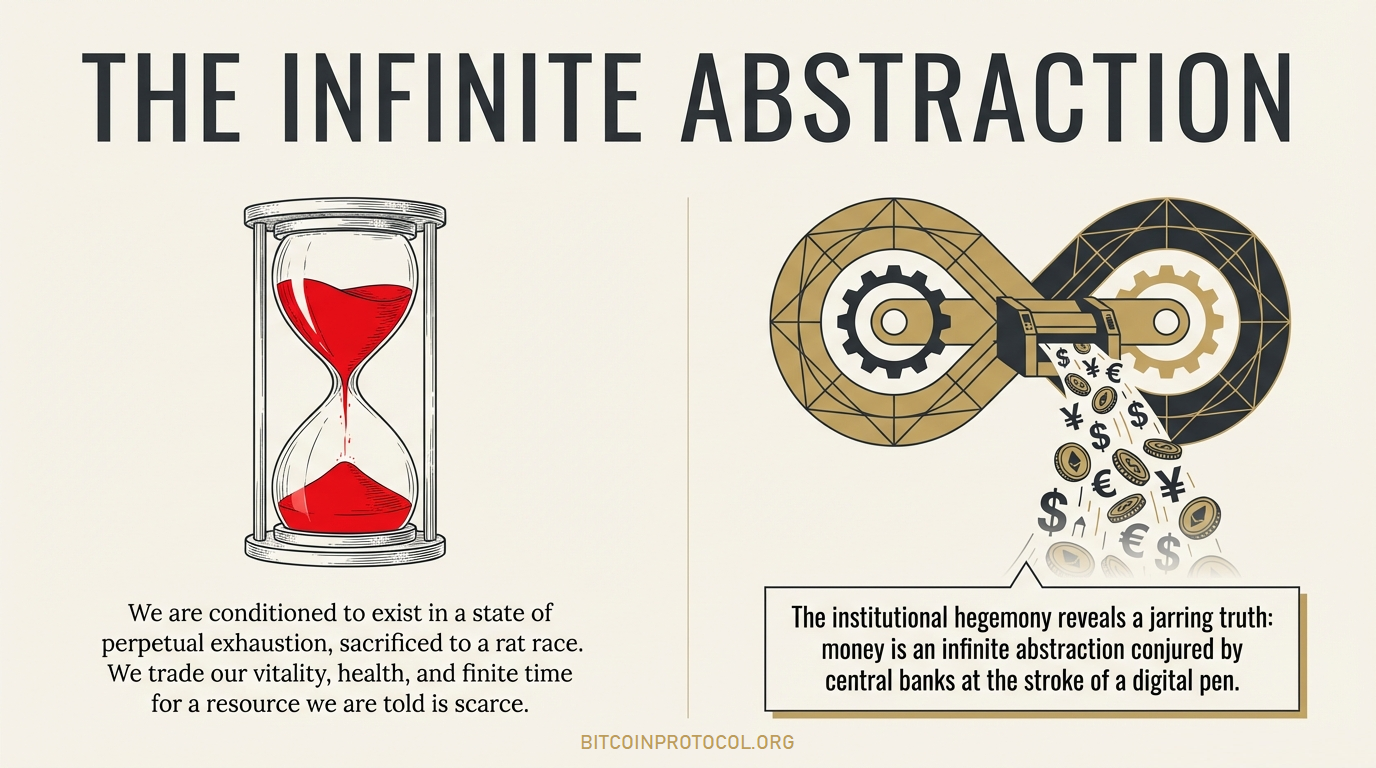
We are conditioned to exist within a state of perpetual exhaustion, sacrificed on the altar of the "rat race" which demands our every waking hour. We trade our vitality, our health, and our very sanity for a resource we are told is finite, yet the institutional hegemony reveals a jarring truth: money is an infinite abstraction.
While the working class is strangled by the tightening noose of inflation and stagnant wages, central banking structures possess the god-like ability to conjure trillions at the stroke of a digital pen. This article intends to dismantle the manufactured veil of scarcity, exposing how the financial elite utilize poverty not as a tragic accident of the market, but as a calculated psychological whip to maintain global social order.
Creating Value from Thin Air
Historically, finance emerged from merchants needing to lubricate the gears of trade. They deposited gold for receipts, a primitive but effective promise of future redemption. This receipt paper became more desirable than the metal because it was portable across borders.
The fraudulence began when bankers realized they could issue more receipts than they held in bullion. By lending out these paper contracts, they effectively doubled their holdings without a single new ounce of gold entering the vault. This receipt trick allowed $10 million in gold to masquerade as $20 million in capital.
Yet, the ontological roots of money are even darker, originating not in trade, but in the symbolic settlement of blood feuds and unpayable debts. In ancient social contracts, money served as a ritualistic apology for murder or a dowry for marriage. It was a mechanism to manage social trauma through abstraction long before it became a tool for the market.
This transition represents the first decoupling of value from physical reality. By transforming a symbolic social contract, the "blood debt", into a tradable receipt, the banking class successfully untethered wealth from the constraints of the material world, laying the foundation for a system predicated on infinite expansion and managed trust.
"I've doubled the gold in my bank... I've created money out of nothing."
The Violent Origins of Central Banking and Cartels
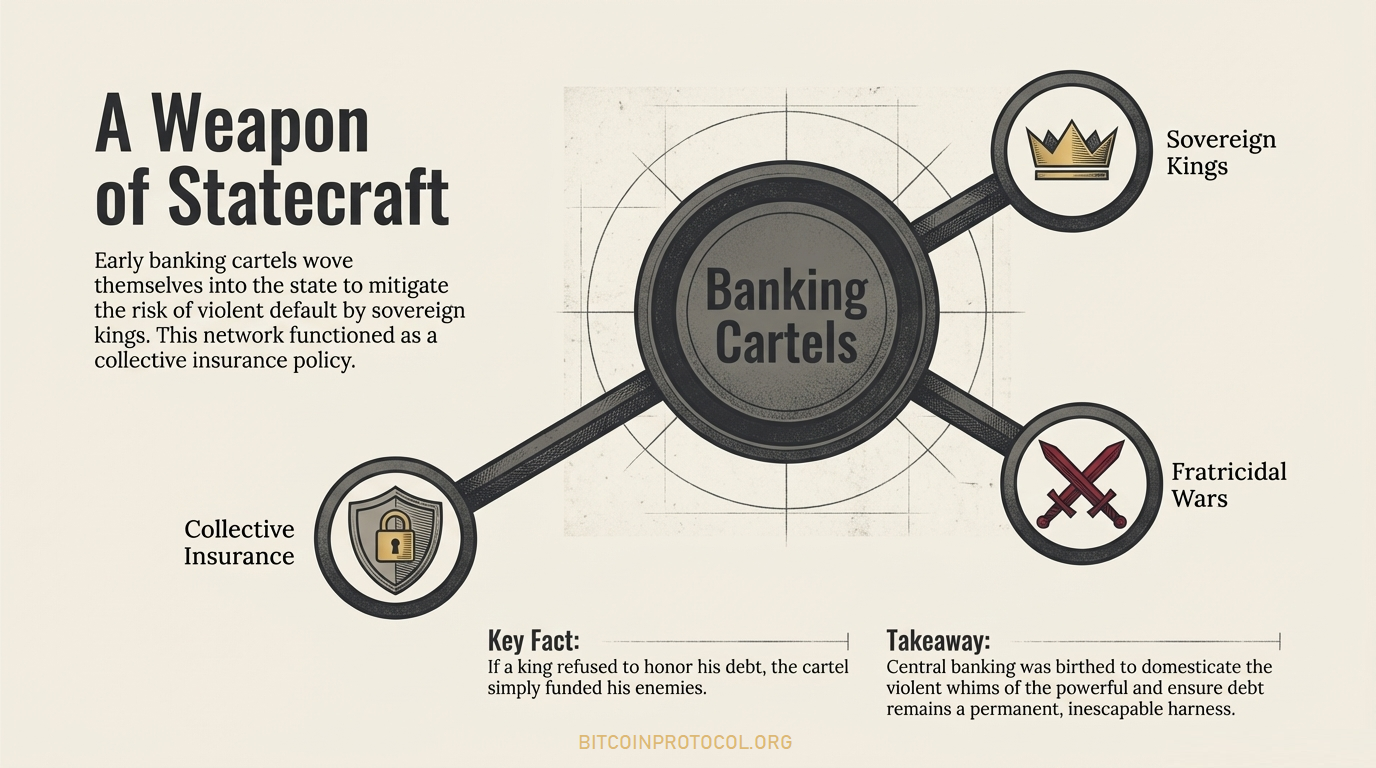
As this parasitic architecture expanded, it required more than just ledgers; it required the power to enforce its illusions. The primary debtors of the early modern era were not humble merchants, but sovereign kings with a propensity for violent default. These monarchs required gold to fund their fratricidal wars, yet they were notoriously unreliable borrowers who would sooner behead a creditor than repay a loan.
To mitigate this existential risk, banking families formed sophisticated cartels, weaving themselves into the fabric of the state through strategic intermarriage and cross-border alliances. This network functioned as a collective insurance policy: if one bank faced a bank run, the cartel provided the liquidity to survive. More importantly, it granted them the power to topple empires. If a king refused to honor his debt, the cartel simply funded his enemies, ensuring his replacement by a more compliant puppet. This evolution from trade support to a violent global control mechanism provided the direct blueprint for the modern central banking system that governs our world today.
We must recognize finance not as a byproduct of economic progress, but as a weapon of statecraft. Central banking was birthed as a means to domesticate the violent whims of the powerful and ensure that debt remains a permanent, inescapable harness for both the peasant and the prince.
Why Poverty is a Social Tool
If money is a social construct that can be printed into infinity, the persistence of global poverty is not a technical failure, it is a deliberate design choice. The central banking apparatus has brainwashed the populace into believing in a scarcity that does not exist. The powerful understand a fundamental truth: if every citizen possessed sufficient resources, the incentive to submit to backbreaking labor would evaporate. Thus, artificial misery is the essential fuel for the economic engine.
Poverty serves as a psychological goad, a visual warning of what happens to those who refuse to play the game. Parents use the specter of the poor person to drive their children into decades of academic and professional servitude. Without the visible agony of the impoverished, the threat used to motivate the workforce would lose its bite. Poverty isn't what you do to yourself; it is what the powerful do to you to keep you running.
Poverty is the ultimate psychological whip. By maintaining a visible class of the suffering, the elite ensure that the middle class remains too terrified of falling to ever look up and question the validity of the currency they are chasing.
"The point of printing money is not to give you money... the point is to create the illusion that money is valuable and therefore you work hard in order to obtain it."
Why We Need Crises and Wars
To sustain the scarcity myth, the system must periodically engage in the ritual destruction of wealth. This explains the counter-intuitive necessity of economic crashes, stock market collapses, and perpetual warfare. When the system becomes saturated with too much capital or too many "credits," the perceived value of money diminishes, and the motivation to work wanes.
Economic crises serve to destroy money, resetting the scarcity mindset of the population through trauma. Similarly, wars are utilized to incinerate physical resources and human lives, reinforcing the lie that the world is a place of limited means. The global economy functions identically to a World of Warcraft type of game engine; the developers must ensure that currency is difficult to obtain to keep the players engaged in the grind. If credits simply flew out of the sky, the game would end, and the players would walk away. By engineering crises, the "game" of modern finance ensures our constant, desperate participation.
Warfare and economic depressions are not failures of the system; they are its maintenance cycles. They purge the excess wealth that threatens to liberate the masses, ensuring that we remain trapped in a gamified reality where the rules are rigged to keep us working.
"Bitcoin has the power to undermine everything they are doing to people around the world. They do it through central banking and the control of the money supply." - Roger Ver, 2015.
— DΛVID (@DavidShares) March 6, 2026
A timely video given the current state of the world. pic.twitter.com/gJN9nZ4z5c
Video: Roger Ver in 2015 discussing on stage how Bitcoin can take away the power from governments and central banking
Reclaiming the Meaning of Value
Ultimately, we inhabit a hall of mirrors constructed by central banking cartels. Money is not a commodity with intrinsic value; it is a mechanism of power designed to extract the maximum possible effort from the human species. The only real value in this entire theater of the absurd is not the currency we hoard, but the human labor we expend to obtain it. We are effectively trading the finite hours of our lives for digital ghosts that can be deleted or multiplied at the whim of the cartel.
The scarcity myth is the most successful de-programming effort in human history. We have been conditioned to ignore the evidence of our eyes, that resources are abundant and money is infinite, in favor of a narrative that keeps us subservient.
If you realized the credits you were chasing were infinite, would you still be playing the same game?
The Bitcoin Rebellion: Hardcoded Scarcity Against Infinite Debasement
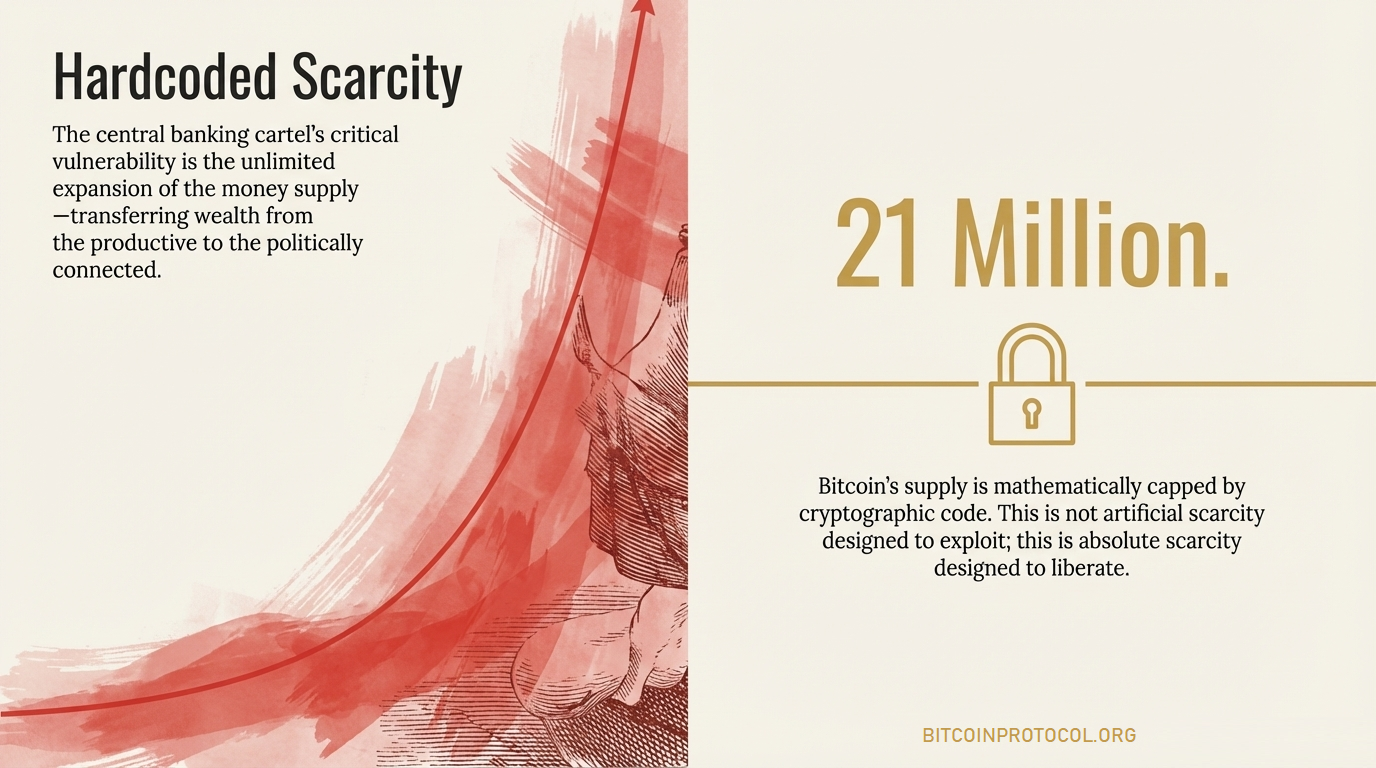
The central banking cartel maintains its stranglehold through a single critical vulnerability: the unlimited expansion of the money supply. Every dollar printed dilutes the value of every dollar held, transferring wealth from the productive to the politically connected. This is not a bug in the system; it is the system's primary feature. But what if there existed a form of money that could not be inflated, debased, or manipulated by any central authority?
Bitcoin represents the first successful technological rebellion against the infinite money printer. Unlike fiat currencies that can be conjured at will by central banks, Bitcoin's supply is mathematically capped at 21 million coins, a limit enforced not by promises or institutional trust, but by cryptographic code that no government, corporation, or cartel can alter. This is not artificial scarcity designed to exploit; this is absolute scarcity designed to liberate.
Where the banking cartel created the "receipt trick" to issue more paper than gold in their vaults, Bitcoin eliminates the vault entirely. There is no trusted third party, no intermediary to corrupt, no banker to issue fraudulent receipts. Every transaction is verified by a decentralized network of peers operating across the globe, making the system immune to the consolidation of power that inevitably corrupts centralized finance. The ledger is transparent, auditable, and immutable; a permanent record that cannot be rewritten by the powerful when it becomes inconvenient.
Bitcoin inverts the power structure of traditional finance. Where central banking concentrates control in the hands of an elite few who benefit from opacity and manipulation, Bitcoin distributes verification across millions of participants who benefit from transparency and mathematical certainty. It transforms money from a weapon of statecraft into a tool of individual sovereignty.
"Not your keys, not your coins."
Escaping the Intermediary Tax
The traditional financial system operates as a series of gatekeepers, each extracting rent for the privilege of accessing your own wealth. Want to send money across borders? Pay the bank. Pay the wire service. Pay the currency exchange. Wait three days. Provide documentation. Prove you are not a criminal. Submit to surveillance. Every transaction is a negotiation with institutions that view you not as a customer, but as a subject requiring permission to move your own property.
Cryptocurrencies annihilate this parasitic architecture. Bitcoin and other cryptocurrencies enable direct peer-to-peer transactions without intermediaries, allowing individuals to send value globally, instantly, and at a fraction of the cost imposed by legacy banking. A farmer in Kenya can receive payment from a customer in Germany without either party needing to genuflect before a bank that will take its cut and monitor their every move. This is not theoretical, it is happening right now, in real time, across every continent.
The implications are profound: if you can transact without permission, you can escape the financial surveillance grid that tracks and controls your behavior. If you can store value in a form that cannot be seized, frozen, or inflated away, you reclaim sovereignty over your economic life. Cryptocurrency transforms money from a leash into a tool of liberation.
By eliminating intermediaries, cryptocurrencies strip the financial elite of their most powerful weapon: the ability to control who can transact and who cannot. This is why central banks and governments view Bitcoin and cryptos with such hostility, it represents an existential threat to their monopoly on monetary coercion.
Banking the Unbanked, Freeing the Enslaved
The legacy banking system is an exclusive club designed to serve those who already have wealth and power. Approximately 1.7 billion adults globally remain unbanked, locked out of the financial system not because they lack value to exchange, but because they lack the documentation, credit history, or geographic proximity to satisfy the gatekeepers. These individuals are condemned to operate in a cash-only shadow economy, vulnerable to theft, unable to save securely, and excluded from participating in the global marketplace.
Cryptocurrencies offer a parallel financial system that requires no permission, no credit score, no proof of address. All that is required is an internet connection and a smartphone, tools that are rapidly proliferating even in the most underserved regions of the planet. This technological leap means that a street vendor in Lagos can now store their wealth in Bitcoin, shielded from the hyperinflation ravaging their national currency, and can accept payments from customers anywhere on Earth without needing approval from a bank that views them as unprofitable.
This is not charity or aid; this is the destruction of financial apartheid through technology. Cryptocurrencies empower the economically disenfranchised to participate in the global economy on their own terms, bypassing the corrupt local institutions and predatory currency regimes that have kept them in poverty.
Financial inclusion through cryptocurrency is revolutionary precisely because it does not ask permission from the existing power structure. It does not petition the central bank for reform or beg governments to expand services. It simply renders them irrelevant by providing a superior alternative that anyone can access.
Power Returned to the Individual
The defining feature of cryptocurrency is not its digital nature, but its reach through decentralization. Traditional money is controlled by central banks, which are controlled by governments, which are controlled by political elites who answer to no one. This concentration of power ensures that monetary policy will always serve the interests of the few at the expense of the many. Inflation is a hidden tax. Currency devaluation is legalized theft. Capital controls are economic imprisonment.
Decentralized cryptocurrencies operate on distributed networks where no single entity holds the power to alter the rules, inflate the supply, or censor transactions. Bitcoin miners, node operators, and users collectively enforce the protocol through consensus. If a government attempts to ban Bitcoin, the network continues to operate. If a corporation attempts to co-opt it, the community can fork away; see for example Bitcoin Cash as a shining example of a contentious Bitcoin fork in the year 2017, highlighting this peaceful decentralized resistance. Or the community can just build another cryptocurrency to compete in an open market, for example Ethereum.
"This resilience is not accidental, it is the product of a system designed specifically to resist centralized control."
By holding cryptocurrency, individuals reclaim monetary sovereignty. Your Bitcoin and crypto wallets are yours alone, controlled by private keys that no bank, government, or third party can access without your explicit consent. This is self-custody in its purest form: the ability to store and transfer value without relying on any institution that might decide to freeze your account, confiscate your property, or devalue your savings to fund wars you did not authorize.
Decentralization is the antidote to the tyranny of centralized monetary control. It shifts power from institutions to individuals, transforming money from a mechanism of state coercion into an instrument of personal freedom. This is why authoritarian regimes fear cryptocurrencies, it enables their citizens to escape the financial cage.
Cryptocurrencies as the Ultimate Opt-Out
The central banking system depends on your participation. It requires that you accept its currency, trust its institutions, and submit to its rules. But what happens when millions choose to exit the game entirely?
Every individual who converts their fiat savings into Bitcoin is casting a vote of no confidence in the legacy system. They are declaring that they no longer trust central banks to preserve the value of their labor. They are rejecting the premise that governments should have the power to inflate away their wealth to fund endless wars and bailouts for politically connected corporations. They are opting out of a rigged game and building a parallel economy based on sound money, individual sovereignty, and voluntary exchange.
This exodus is already underway. From various countries and people adopting Bitcoin and cryptocurrencies, to multinational corporations adding it to their balance sheets, the world is slowly waking up to the reality that fiat currency is a confidence game, and confidence is eroding. As more people recognize that the credits they are chasing are infinite, they will stop chasing them and start holding assets that cannot be debased.
The scarcity myth thrives in darkness, sustained by the illusion that there is no alternative. Cryptocurrencies are the light that exposes the lie. It proves that money can exist without central banks, that value can be stored without trusting institutions, and that financial freedom is not a utopian fantasy - it is a technological reality available to anyone with the courage to claim it.
If the powerful have taught us anything, it is this: the only real power is the power to say no. Crypto gives us that power. The question is not whether you can afford to adopt it. The question is whether you can afford not to.