
Crypto, Jared Kushner, and the Shadow Network Behind the Money Flows


When the Justice Department quietly released a tranche of FBI interviews and internal Deutsche Bank records as part of the recent Epstein files, most of the recent news headlines have been focused on Jeffrey Epstein. But buried in the documents is a different story, one that sits at the intersection of cryptocurrency, opaque capital flows, and the financial networks surrounding President Trump's son-in-law, Jared Kushner.
The picture that emerges is not a single explosive revelation. It’s something more subtle and more troubling: a pattern of red flags raised, minimized, or buried; a bank that repeatedly chose not to ask hard questions and to look the other way for powerful and wealthy people. And a set of overlapping relationships including Epstein, Apollo, Russian‑linked investors, Chabad‑connected donors, all that kept circling back to Kushner’s financial sphere.
And at the center of it all is a little‑known business with a name that now reads like a warning: REAL CONTRAD.
The Kushner Crypto Flows Deutsche Bank Didn’t Want to See
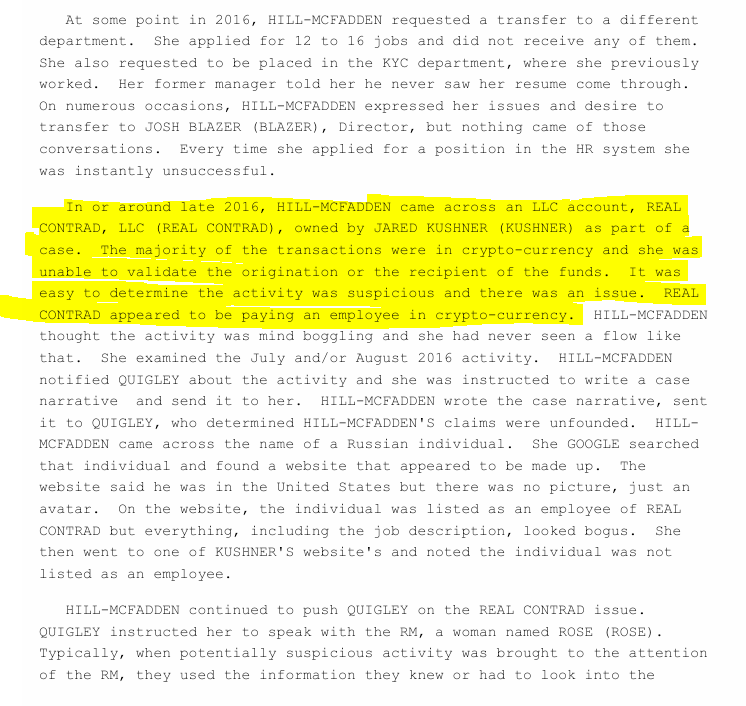
In late 2016, Deutsche Bank anti‑money‑laundering officer Tammy Hill‑McFadden stumbled onto something she had never seen before. As she told the FBI in 2019, she was reviewing a case when she discovered an account belonging to REAL CONTRAD, LLC, an entity owned by Jared Kushner.
What she saw immediately set off alarms. She told the FBI:
“The majority of the transactions were in crypto‑currency and she was unable to validate the origination or the recipient of the funds. It was easy to determine the activity was suspicious and there was an issue. REAL CONTRAD appeared to be paying an employee in crypto-currency.”
Crypto transactions flowing through a politically exposed person’s corporate account, with no verifiable counterparties, is the kind of thing that normally triggers a full‑scale review in the banking world. Instead, Hill‑McFadden says she was told to write a case narrative and send it up the chain. She did. And then:
“After that, the case was closed.”
No SAR. No escalation. No account closure. Just eerie silence.
Hill‑McFadden dug deeper. She found a Russian individual tied to the flows whose online presence appeared fabricated: no photo, no verifiable employment, just an avatar and a vague job description. She checked Kushner’s own corporate website. The individual wasn’t listed anywhere.
She recommended closing the accounts. The recommendation went nowhere. And then, her work life changed.
She told the FBI that after raising the issue, her productivity scores were suddenly downgraded, her work was rejected at unusually high rates, and her performance reviews which were previously strong, turned sharply negative. She believed she was being retaliated against.
Her experience wasn’t isolated. Around the same time, she discovered 102 politically exposed person (PEP) cases sitting in a "deferred" status, effectively a black hole where alerts go to die. She reported it. Nothing happened, again.
Inside Deutsche Bank, heavy crypto flows tied to the Kushner family member were not treated as a crisis. They were treated as something to be quietly put away.
Russia Wires and a Culture of Minimization
Another Deutsche Bank compliance officer, Cherie Quigley, told the FBI about a separate Kushner‑linked alert: a $4,000 wire sent from a Kushner corporate account to Russia.

In the conversation with the FBI about suspicious transactions, she said she recalled being unsure about issues such as Bitcoin and marijuana, and reporting parameter thresholds.
“The transaction involved four thousand dollars ($4,000) sent to Russia out of a KUSHNER corporate account. MCFADDEN looked at a GODADDY website and found someone in New Hampshire and found part of the KUSHNER business name. The information was sent to the relationship manager and it was determined the recipient was a software developer."
Quigley emphasized that this was the only Kushner issue she remembered being escalated. She also said she "had not experienced a culture of sweeping issues under the rug."
Hill‑McFadden’s account directly contradicts that. She described a department where internal suspicious activity reports "didn’t go anywhere," where raising concerns could damage your career, and where high‑risk cases could be quietly buried in the system.
The tension between these two accounts is revealing. Some red flags were technically "resolved." Others dealing with high profile clients (PEPs) were quietly neutralized. And the bank’s own staff couldn’t agree on whether that was a feature or a flaw.
Epstein and Kushner: Parallel Tracks Inside the Same Bank
While Deutsche Bank was debating what to do with Kushner’s crypto flows, it was also expanding its relationship with Jeffrey Epstein.
In December 2016, assistant vice president Cynthia Rodriguez emailed senior management requesting approval for a new Epstein entity:
“I am requesting Exco Approval for Zorro Management, LLC, under the Jeffrey Epstein relationship… This relationship is deemed high risk due to multiple court cases on Jeffrey Epstein…”
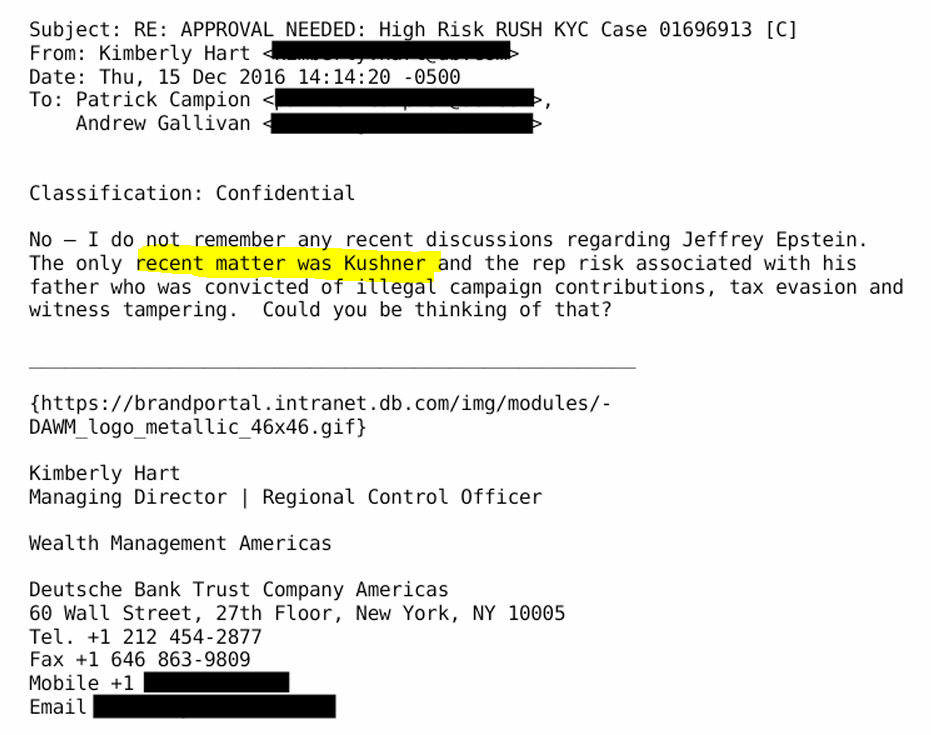
When regional control officer Kimberly Hart was asked whether Epstein had come up recently, she replied:
“No - I do not remember any recent discussions regarding Jeffrey Epstein. The only recent matter was Kushner and the rep risk associated with his father who was convicted of illegal campaign contributions, tax evasion and witness tampering.”
Inside Deutsche Bank, Epstein and Kushner were not separate universes. They were part of the same risk landscape, handled by the same people, same departments, in the same time frame, with the same institutional blind spots, part of a larger banking cartel.
Hill‑McFadden told the FBI she saw Epstein wiring money to young women and to a French art dealer. She recommended closing the relationship. The bank kept him and continued doing business with him which involved tens of millions of dollars over the years.
She also noted that Epstein’s attorney, Darren Indyke, withdrew $7,500 in cash every week, enough to trigger a suspicious activity report. A SAR was filed on Indyke. But, Epstein remained a client.
The bank that ignored crypto red flags tied to Kushner was the same bank that continued servicing Epstein long after his first conviction.
Leon Black, Apollo, and the Lifeline to 666 Fifth
While Deutsche Bank compliance officers were wrestling with unexplained crypto flows and Russia‑linked wires, another financial relationship was quietly propping up Jared Kushner’s most distressed asset: 666 Fifth Avenue.

The first hints of how sensitive this relationship had become appear in a 2016 text message thread between Leon Black and Jeffrey Epstein. In the exchange, Black forwards Epstein a New York Times article detailing how Kushner’s family business had received major financing from Apollo Global Management, the private‑equity giant Black co‑founded. The message contains no additional commentary outside of the article and a photo from the article with Jared Kushner and Leon black sitting together at the 2016 Tennis US Open. The timing is notable: Black was already under scrutiny for his long, opaque financial relationship with Epstein, and here he was flagging a story about Apollo’s support for Kushner.
Two years later, the political pressure around those loans had intensified. In a 2018 iMessage exchange between Steve Bannon and Epstein, Bannon brings it up directly:
“Did u see the senate / Warren going after Leon Black on the Kushner loans”
Epstein replies that the loans came from a division of Apollo “with no real oversight,” adding:
“Yes, its a division of Apollo with no real oversight. No there, there”
The subtext is unmistakable: the loans were politically radioactive, and both men knew it.
By that point, the scale of Apollo’s support was public. The firm had extended $184 million to Kushner Companies at a moment when 666 Fifth was hemorrhaging cash and facing a looming debt crisis. The optics were troubling enough that even inside the Trump orbit, people were bracing for fallout.

Then, in 2020, an FBI confidential human source added a new layer of context. In a report summarizing the source's statements, FBI agents made note that:
“Leon Black owns the mercenary firm formerly known as Blackwater, now Constellis, which has been accused of being involved in several arms and human trafficking scandals. Black is also the CEO of Apollo. "@NYTimes" noted that Black "inexplicably stood by Jeffrey Epstein. recently giving him $50M." Apollo also lent the Kushners $184 million (USD) while Kushner was facing his 666 5th Avenue disaster.”
The source’s claims echo a pattern visible across the documents: the same small circle of financiers Black, Epstein, Kushner, are intersecting at moments of maximum financial vulnerability and minimum transparency.
The source made other damning allegations, all notated by the FBI.
"Harvard Law Professor Alan Dershowitz (Dershowitz). CHS learned that Dershowitz influenced many students from wealthy families. For example. Josh Kushner (Josh) and Jared Kushner (Jared) were both his students. Dershowitz told CHS that if he were young again, he would be holding a stun gun as an Israeli Intelligence (Mossad) agent. CHS believed Dershowitz was co-opted by Mossad and subscribed to their mission. CHS still continues to communicate occasionally for Dershowitz."
"Jeffrey Epstein (Epstein) was represented by Dershowitz. CHS remembered Dershowitz tell Alex Ocasta (U.S. Attorney of Southern District of Florida at the time) that Epstein belonged to both U.S. and allied intelligence services. CHS shared phone calls between Dershowitz and Epstein during which he/she took notes. After these calls, Mossad would then call Dershowitz to debrief. Epstein was close to the former Prime Minister of Israel, Ehud Barak (Barak) and trained as a spy under him. Barak believed Netanyahu was a criminal. Saudi Arabia, Israel and the United Arab Emirates (UAE) are allied against Qatar, Turkey, Iran and Syria. One of CHS' (who presumably worked) asked CHS a lot of questions about Epstein. CHS became convinced Epstein was a co-opted Mossad Agent."
One notation talks about Masha Drokova, where in the document it's claimed that Drokova's Day One Ventures "was in Silicon Valley to steal technology." We previously reported how Drokova met with Epstein and they frequently communicated, where she once touted a blockchain prodigy that was better than Vitalik Buterin.
Black’s relationship with Epstein is well‑documented; in email exchanges between Joi Ito and Epstein, Ito says that "We were able to keep the Leon Black money," using funds from Leon Black to help fund MIT Media Labs and Bitcoin and cryptocurrency development.
Apollo’s loans to Kushner are publicly confirmed as well; and the text messages show that senior political figures were acutely aware of the reputational risk. What remains unclear is why Apollo stepped in when it did, and why Black, who was already entangled with Epstein, was willing to take on the political exposure of rescuing the president’s son‑in‑law.
What is clear is that the overlap wasn’t incidental. Epstein, Black, Apollo, Kushner, the circles don’t just touch; they repeatedly converge at the precise points where money, power, and influence meet.
Chabad, Cadre, and the Intelligence‑Style Allegations
The most aggressive claims come from that same FBI confidential source, who described Kushner as a central node in Russian‑linked capital flows and Chabad‑connected influence networks.

“Jared didn't disclose his stake in Cadre, because of its ties to the Russian state (NFI)...Kushner has moved a lot of Russian investment money around. The FBI should investigate Kushner's family charities to find evidence of corruption and money laundering. Chabad routinely uses charities to launder money.”
The source also alleged:
“Chabad is doing everything they can to co-opt the Trump presidency. Chabad is basically state-sanctioned Judaism. It is used by Putin to keep tabs on all the Russo-Jewish oligarchs. On the day Trump was elected President, Ivanka Trump (Ivanka) and Jared were at the gravesite of Rabbi Scheersom, who was the most powerful Rabbi in the Chabad network.”
To be clear, these are assessments, not proven facts or evidence. But they echo other pieces of this large puzzle: Deutsche Bank’s crypto alerts, the Russian wire, Epstein’s email claiming the Paradise Papers showed “the kremlin funneling money to kushner by using uri milner,” and the Apollo loans.
Individually, each data point is ambiguous. Together, all of this forms a pattern leading to a bigger picture: Kushner as a conduit between Western real estate, opaque capital, and geopolitical influence, and how he was using cryptocurrency as the rails.
What's Proven, What Isn't, and Why It Matters
There is no single document in the Epstein archives that unilaterally proves Jared Kushner laundered money, coordinated with foreign intelligence, or used crypto to move illicit funds.
But the absence of proof is not the same as the absence of red flags.
Here’s what is documented:
- A Kushner‑owned company with heavy crypto money flows that Deutsche Bank could not verify.
- A compliance officer recommending account closure, and being ignored, with the bank effectively looking the other way.
- A separate wire from a Kushner corporate account to Russia.
- A bank that kept Jeffrey Epstein as a client while discussing Kushner in the same risk context.
- A financier [Black] who supported both Epstein and Kushner’s real estate empire.
- An intelligence source alleging that Kushner’s financial networks intersect with Russian‑linked capital and Chabad‑connected donors.
None of these documents by themselves tell the full story. But combined together, they reveal how the Kushner family and modern influence networks move money and whose financial relationships already operated in the gray zones of global capital: quietly, digitally, and without the friction that once made these flows visible.
It also shows one of the most powerful political figures in America, directly tied to President Trump, was quietly moving crypto through a global bank that didn’t want to look too closely because of who and how powerful they are.
We created an Epstein Bitcoin Email archive to go through all the newly released Epstein emails relating to Bitcoin, cryptocurrency, and blockchain, to search through all the communications for important information relating to this topic. Try it out!