
Silk Road Agents Thought Bitcoin Would Hide Them, It Did Not


In January 2013, federal agents staged one of the more unusual operations in the history of digital law enforcement. A controlled delivery of cocaine was sent to Curtis Green, a 47-year-old Silk Road moderator living in Spanish Fork, Utah, who answered his door with a pink walking cane and two Chihuahuas by his side. When he opened the package out of curiosity, cocaine filled the air and a SWAT team breached his front door, finding Green covered in white powder with $23,000 in cash stashed in his fanny pack. The arrest was meant to be the first domino in taking down "Dread Pirate Roberts," the anonymous operator behind the dark web's most notorious drug marketplace.
What followed, however, was far more complicated than a straightforward law enforcement takedown. The Marco Polo Task Force, assembled to unmask the Silk Road's creator, became compromised from within when two of its own agents began exploiting the investigation for personal gain. Special Agent Shaun Bridges of the Secret Service used his administrative access to hijack Green's moderator account and steal funds directly from Silk Road vendors, while DEA Special Agent Carl Force created a web of fake digital personas to extort the site's operator for hundreds of thousands of dollars in Bitcoin.
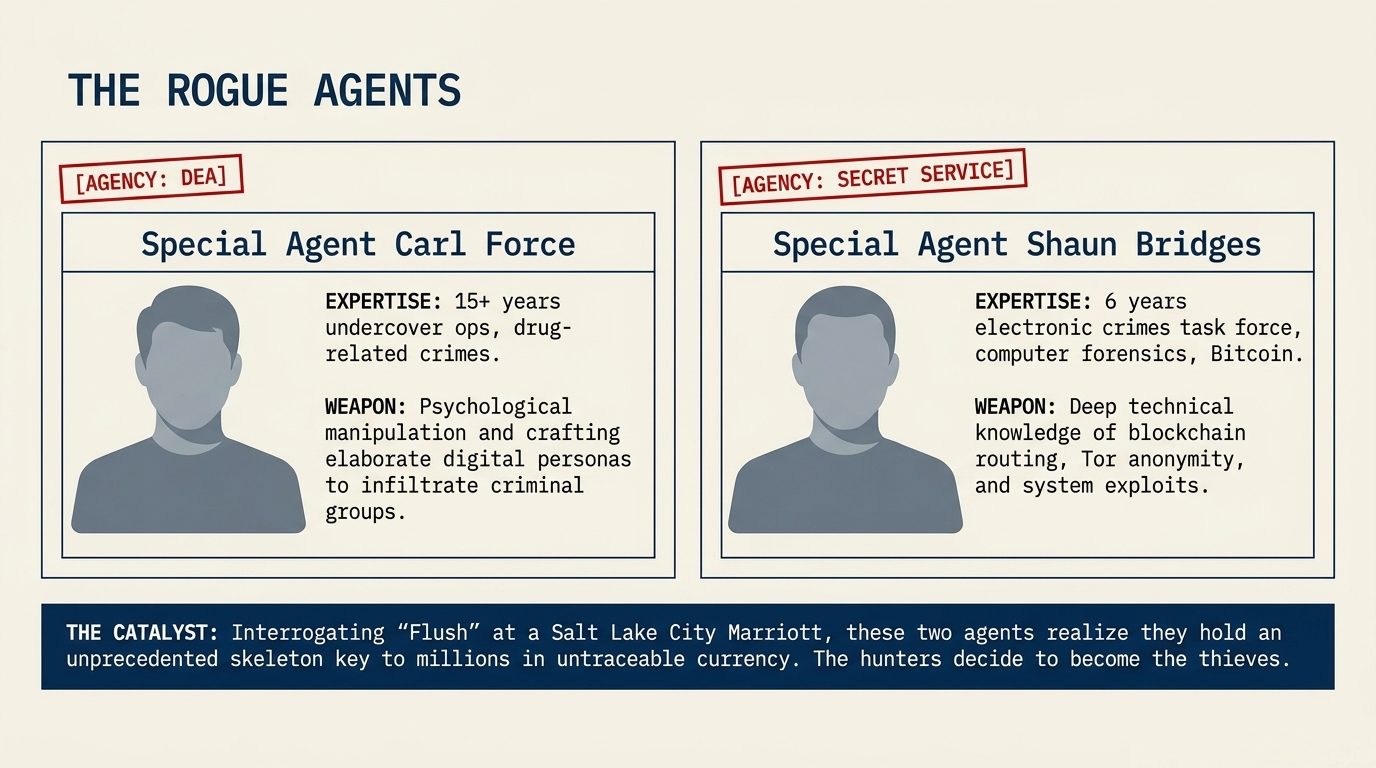
A Staged Murder and a Blockchain Paper Trail
After Bridges stole the funds and framed Green for the theft, Silk Road's operator ordered a hit on the moderator, believing him responsible. Federal agents used the opportunity to stage a fake torture and execution at a Marriott Hotel, eventually photographing Green on a bathroom floor with Campbell's soup standing in for more gruesome props. The operator paid $80,000 in Bitcoin for what amounted to a fabricated crime scene photograph, and the transaction was recorded permanently on the blockchain.
That immutability would contribute to the unraveling of their entire scheme. IRS Special Agent Tigran Gambaryan traced the stolen funds from Silk Road's servers through the Mt. Gox exchange and directly into the personal bank accounts and offshore companies of Force and Bridges, which essentially proved to be their downfall. The blockchain, which both the corrupt agents and the Silk Road's operators believed offered financial anonymity, instead served as an unalterable ledger of every transaction they had ever made. The Bitcoin blockchain was just part of the puzzle, however, as the agents' use of their personal bank accounts ultimately sealed their fate.
Force was sentenced to 6.5 years in prison and ordered to pay a $340,000 fine, while Bridges received six years and later earned an additional 24 months after attempting to flee the country with another 1,600 Bitcoin stolen from a government wallet.
Ross Ulbricht, the man behind the Dread Pirate Roberts persona, was arrested in a San Francisco public library in October 2013 with his laptop open and running. He had founded the Silk Road on libertarian economic principles, claiming the platform would empower people to live outside state control. Yet internal records from the investigation showed that when his marketplace faced internal theft and competitive pressure, Ulbricht sought out hired violence through the same agents who were simultaneously robbing him. He was ultimately sentenced to two life terms plus 40 years, though President Donald Trump granted him a full and unconditional pardon in 2025.
The Silk Road case stands as one of the earliest demonstrations of how blockchain forensics can support a criminal investigation, though it was far from the only factor at play. The corrupt agents ultimately exposed themselves by moving stolen funds into personal bank accounts and offshore shell companies, leaving a trail that existed well beyond the blockchain. What the Bitcoin ledger provided was a starting point, a verifiable record of where the money originated and how it moved, but it was the agents' own financial footprints in the traditional banking system that closed the case. For the Bitcoin and crypto industry, the investigation served as an early reminder that the Bitcoin blockchain is a transparent tool, not a shield, and that those who misuse it rarely stop making mistakes at the chain itself.
Now in 2026, there are non-transparent private blockchains which shield their users' anonymity, and provide full private transactions, such as Zano, Monero, and others.
Sentiment Analysis
Loading market sentiment…