
Russian Operative Touted Blockchain Prodigy Better Than Vitalik Buterin in Epstein Emails


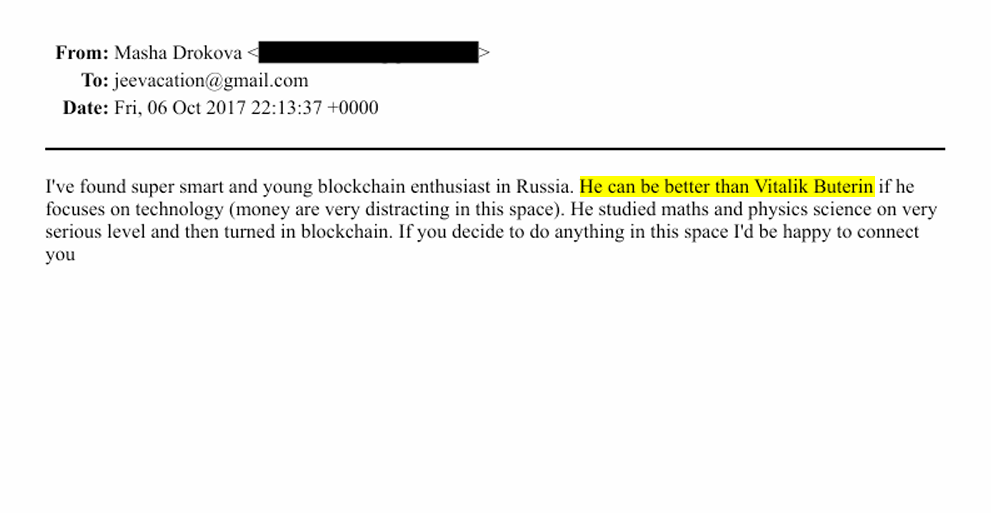
Buried in the overlap between Silicon Valley VC's, Russian influencers, and Jeffrey Epstein’s network, a 2017 email from Masha Drokova (now Masha Bucher) stands out.
"I've found super smart and young blockchain enthusiast in Russia. He can be better than Vitalik Buterin if he focuses on technology (money are very distracting in this space). He studied maths and physics science on very serious level and then turned in blockchain. If you decide to do anything in this space I'd be happy to connect you"
This message she wrote to Epstein, we unearthed in the U.S. Department of Justice's massive 2026 file dump of over 3.5 million documents, not only highlights Bucher's deep involvement in Epstein's orbit but also her ambitions in the growing world of cryptocurrencies like Bitcoin and Ethereum.
As a high-profile female VC in Silicon Valley, Bucher positioned herself as a bridge between Eastern European talent and Western capital, but at what cost?
From Putin's Kiss to Silicon Valley Stardom
Masha Bucher, formerly Drokova, didn't arrive in the U.S. tech scene by accident. Born in Russia, she gained notoriety as a teenage leader in Nashi, a pro-Kremlin youth movement infamous for its anti-Western protests and loyalty to Vladimir Putin. In a 2011 propaganda video titled "Putin's Kiss," a young Drokova is seen planting a kiss on Putin's cheek, a moment that symbolized her deep ties to the Russian regime. By her early 20s, she claimed to have made her first million and secured an EB-1 visa in 2013, sponsored by a Swiss investor, allowing her to relocate to the U.S. Between 2014 and 2021, she made over 20 trips back to Russia, all while building her career in public relations and venture capital.
In Silicon Valley, Bucher quickly ascended to become one of the most prominent female VCs. She founded Day One Ventures in 2016, starting with a modest $10 million fund that ballooned to over $100 million in assets under management. Her portfolio boasts investments in cutting-edge startups like OpenAI, World (Worldcoin), and even Russian-linked facial-recognition firm NtechLab, alongside oligarchs like Roman Abramovich.
But her success has been marred by allegations of being a "Kremlin Bag Washer", a term used by intelligence analysts to describe her alleged role in laundering Russian oligarch funds into U.S. tech ventures, often through offshore entities like those in the Cayman Islands. According to a detailed report by AF Post, Bucher's firm draws over 90% of its capital from non-U.S. sources, with ties to Russian quantum computing hubs like Skolkovo, which the FBI flagged in 2014 as potential intelligence-gathering operations.
Her connections extend to figures like Serguei Beloussov, a Russian-born entrepreneur with links to oligarch Oleg Boyko, further fueling suspicions of her as an intermediary for Kremlin interests in strategic technologies.
The Epstein Connection Exposed
The 2026 DOJ releases have thrust Bucher's relationship with Epstein into the spotlight, revealing a "deep, years-long" partnership that went far beyond casual networking. Bucher appears in Epstein's emails over 1,600 times between May 2017 and June 2019, coordinating introductions to scientists in fields like quantum computing, AI, nuclear technology, neuroscience, and blockchain, including Dmitry Buterin (Vitalik's father).
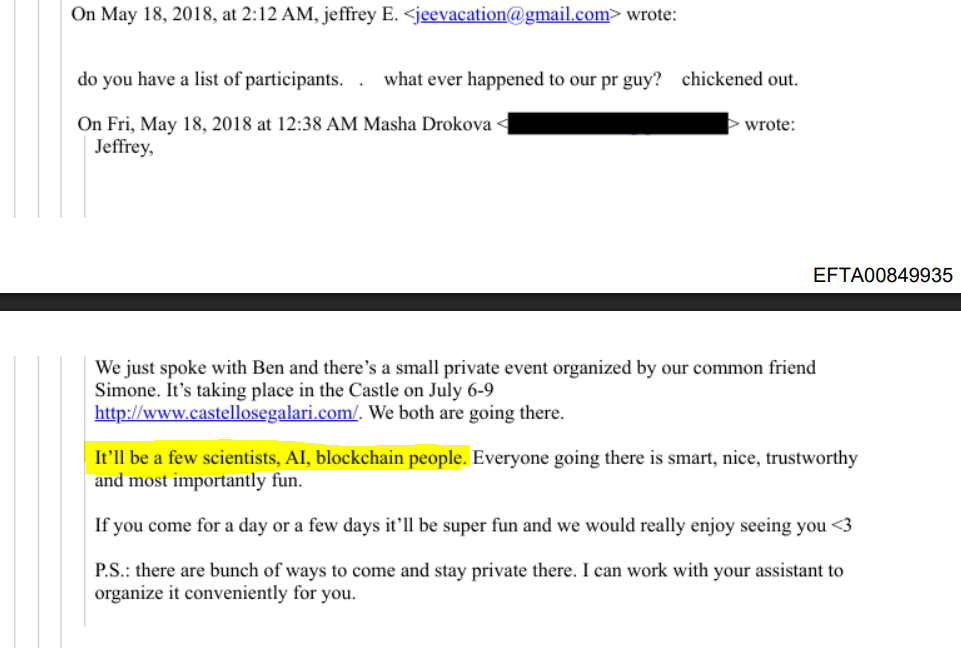
She set up meetings for Epstein with reporters from prestigious outlets like Forbes, Nature, and The Times, aiming to rehabilitate his tarnished image through profiles on his "philanthropy." Bucher also facilitated connections between Epstein and entrepreneurs, including a video call with Bryan Johnson of Kernel on brain-computer interfaces and an introduction to 20-year-old AI security whiz Neil Serebryany.
Their collaboration extended to more personal matters: Bucher recruited young assistants for Epstein, specifying criteria like age (20-24) and appearance, and handled reimbursements totaling thousands, including hotel stays and luxury gifts like a black Prada handbag. They met in person as late as June 2019 in Epstein's Paris mansion, just 17 days before his arrest. An FBI document from April 2025 even describes an ongoing blackmail operation in Silicon Valley, akin to Epstein's, involving Bucher's network, raising questions about whether her VC role served as a front for influence peddling.
Epstein's broader Russian ties, mentioned nearly 10,000 times in the files with over 1,000 references to Putin, add another layer of intrigue. Bucher, with her Nashi roots, was a key contact in this web, potentially linking Kremlin agendas to U.S. tech elites.
Manipulating Crypto and Recruiting Prodigies
Bucher's Epstein emails delve deeply into cryptocurrencies, showcasing her savvy in the space. In one 2017 email, she advised Epstein on leveraging his influence:
"You can manipulate bitcoin [of] course giving comments about bitcoin, ethereum or other 'currencies'."
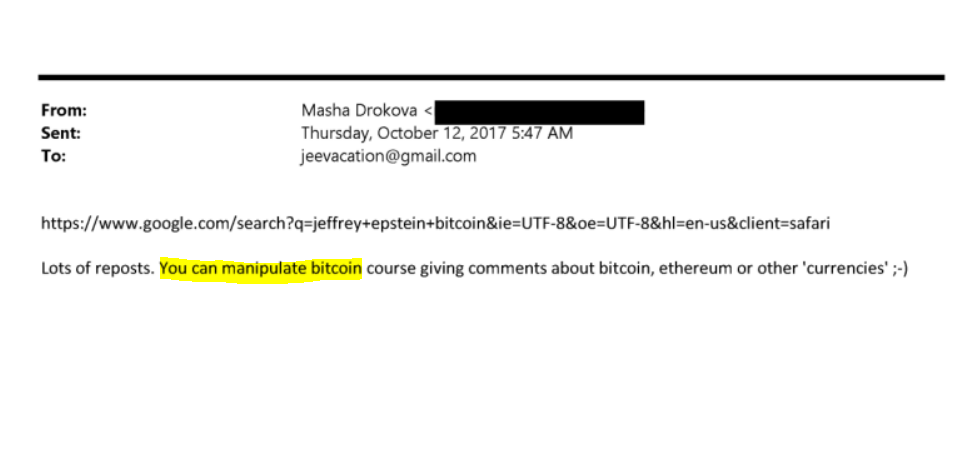
This suggestion came amid Epstein's own crypto ventures, including a $3 million investment in Coinbase in 2014, and his other major investment in Blockstream. Bucher, who knew Ethereum co-founder Vitalik Buterin personally through her tech circles, positioned herself as a scout for emerging talent that could rival or surpass him.
The standout email is her October 2017 pitch about the unnamed Russian blockchain enthusiast, a "super smart and young" individual with a rigorous background in math and physics who pivoted to blockchain. Bucher hyped him as potentially "better than Vitalik Buterin" if he avoided the distractions of money, offering to connect him directly to Epstein for potential collaborations or investments.
This wasn't just networking; it reeked of recruiting for Epstein's influence machine, possibly to gain leverage in the crypto world where Russian talent was booming amid sanctions and global scrutiny.
Speculating on the Mystery Blockchain Prodigy
Who was this prodigy Bucher dangled before Epstein? While the emails don't name him explicitly, the description, Russian roots, elite math/physics education, and a blockchain pivot, points to a handful of prominent figures. Here's a breakdown of the top persons of interest:
- Sergey Nazarov (Chainlink Founder): Often speculated due to Chainlink's 2017 ICO timing, Nazarov is Russian-born and entered crypto early (around 2011). However, his NYU philosophy degree doesn't match the "maths and physics science on very serious level" criterion, making him a weaker fit despite his oracle network's Ethereum integrations.
- Nikolai Durov: Brother of Telegram founder Pavel, Nikolai holds a PhD in mathematics from Saint Petersburg State University and boasts International Math Olympiad golds. His pivot from academia to tech included architecting the Telegram Open Network (TON) blockchain, which raised $1.7 billion in 2018. At 37 in 2017, he was "young" in tech terms, and his focus on scalability echoes Buterin's Ethereum innovations. Bucher's Kremlin ties could easily grant access to the Durov circle.
- Pavel Durov: The more public Durov brother, Pavel founded VK (Russia's Facebook) before Telegram and TON. While his economics background is less math-heavy, he collaborated closely with Nikolai on blockchain tech. Pavel's anti-government stance might appeal to Epstein's contrarian network, but the email's emphasis on pure technical focus leans toward Nikolai as the better match.
Other possibilities include lesser-known devs like Waves founder Alexander Ivanov (physics/cosmology background, Waves launched in 2016) or IOTA's Serguei Popov (math PhD). Ultimately, the identity remains unknown, but Bucher's pitch shows her role in funneling Russian crypto talent into potentially compromising alliances.
Influence, Blackmail, and Crypto Dynamics
These revelations paint a picture of Bucher as a pivotal figure in a nexus of power, where crypto served as both opportunity and tool. Epstein's files suggest broader Russian efforts to infiltrate U.S. tech, with Bucher allegedly bridging oligarch money to startups in AI, quantum, and blockchain, fields with dual-use potential for military or economic leverage.
Her Epstein collaboration, including crypto market manipulation ideas, raises ethical alarms about how influence peddlers can exploit volatile assets like Bitcoin, Ethereum, and others.
We created an Epstein Bitcoin Email archive to go through all the newly released Epstein emails relating to Bitcoin, cryptocurrency, and blockchain, to search through all the communications for important information relating to this topic. Try it out!