
Inside the Overlooked Ties Between Epstein, Chaincode Labs, and Bitcoin

A newly released set of Jeffrey Epstein’s emails is shedding light on an overlooked chapter of Bitcoin’s early institutional history. The documents, spanning 2014 to 2018, show Epstein taking a sustained interest in the emerging Bitcoin and crypto ecosystem and, more notably, cultivating direct ties to one of its most influential development hubs named Chaincode Labs.
Founded in 2014 by Suhas Daftuar and Alex Morcos, two quantitative trading engineers from Hudson River Trading, Chaincode Labs has quietly become a linchpin in Bitcoin's evolution. It funds open-source developers, runs elite training programs, and has backed major Bitcoin code changes such as SegWit and Taproot. Without Chaincode, Bitcoin might still be mired in the Block Size Wars of its turbulent formative years.
But here's the bombshell: Daftuar and Morcos were introduced to Jeffrey Epstein himself, with plans for a face-to-face meeting in New York City. This wasn't some fleeting email chain, it was a deliberate bridge built by Bitcoin Core contributor Jeremy Rubin, who positioned Chaincode as a prime example of innovative crypto R&D. While direct funding from Epstein to Chaincode remains tantalizingly opaque, the ties run deeper than a casual coffee chat. Epstein's web of influence, through MIT's Digital Currency Initiative, Joi Ito's Media Lab, and direct investments in similar blockchain companies Blockstream and Coinbase, created a fertile ground for influence. And the developer crossovers? They're a revolving door that blurs the lines between these Epstein-backed entities and Chaincode, potentially steering Bitcoin's path in ways we're only now beginning to unpack.
This isn't just noise. Chaincode's fingerprints are all over Bitcoin's history. If Epstein's shadow touched its origins, it demands we revisit the networks that built the world's most revolutionary money.
Epstein's Crypto Gambit: Predator to Pioneer
Jeffrey Epstein wasn't just a financier with a private island; he was a calculated opportunist who saw Bitcoin as the ultimate tax haven and power play. By 2014, as Bitcoin clawed its way out of obscurity post-Mt. Gox collapse, Epstein was already wiring millions into the space. He funneled $3 million into Coinbase via early investor Brock Pierce and dropped $500,000 on Blockstream, the company that would later champion offchain layer two's such as the Lightning Network. He also lavished $850,000 on MIT between 2002 and 2017, with $525,000 earmarked for the Media Lab's Digital Currency Initiative (DCI), led by Joi Ito. That funding plugged a critical gap in 2015, bankrolling Bitcoin Core developers like Gavin Andresen and Wladimir van der Laan after the Bitcoin Foundation imploded.
Epstein wasn't hands-off. Emails show him grilling founders on regulatory loopholes, speculating on Bitcoin's political fate, and even pitching "Ponzi gambling" schemes with a wink. His goal? Not just profit, but influence over Bitcoin and it's future, steering the tech through devs, donations, and discreet dinners.
Enter Chaincode Labs, the self-funded powerhouse that stepped in where MIT left off, employing Core maintainers and auditing Bitcoin code changes and upgrades. If Epstein funded the upstream (MIT, Blockstream), did his tendrils reach Chaincode downstream? The files suggest just that with proximity, and if not, direct cash.
Binding Emails: Intros, Tax Schemes, and NYC Rendezvous
The smoking gun lies in a handful of Epstein's archived emails, unearthed in the recent 2026 Epstein document dump. They paint a picture of eager networking, with Rubin as the enthusiastic matchmaker. A MIT alum and Bitcoin tinkerer, Rubin had been involved with Epstein since 2014, visiting his Manhattan townhouse and floating investment ideas to mask the financier's toxic rep. By 2016, Rubin was name-dropping Chaincode like a golden ticket.
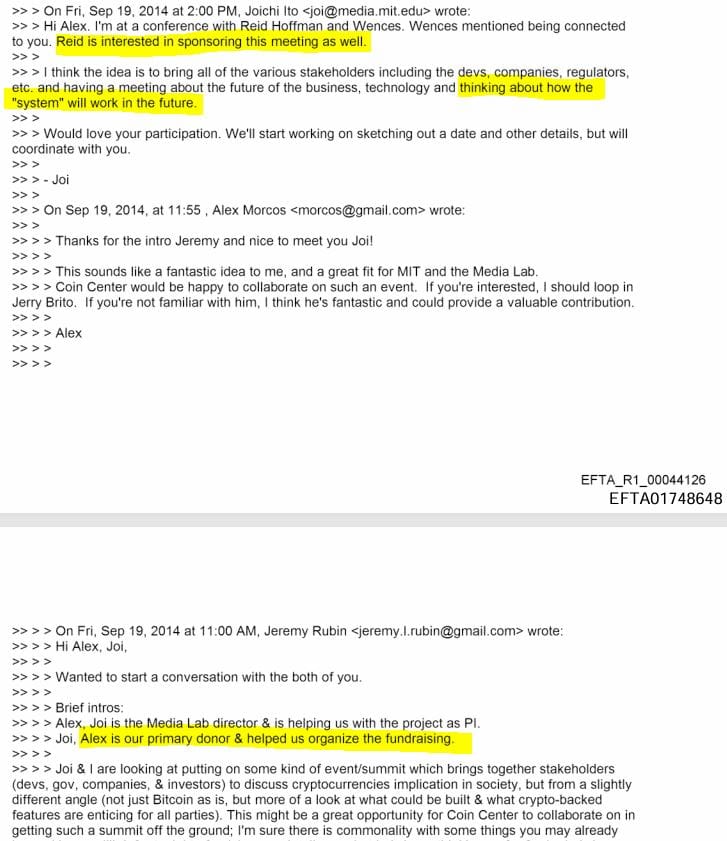
In September 2014, Rubin intro's Joi Ito and Alex Morcos from Chaincode, writing "Alex is our primary donor & helped us organize the fundraising," including Epstein on the emails. In a direct follow up email, Joi Ito writes that Reid Hoffman is interested as well, and how they all are "thinking about how the [Bitcoin] "system" will work in the future."
Later, in 2016, Jeremy Rubin sends another email re-introducing Alex, and also first time introducing Suhas Dafuar, both of them as part of Chaincode Labs. Jeremy wrote,
"Hi Suhas, Jeffrey, wanted to introduce you guys. Suhas is one of the founders of Hudson River Trading and is now running a Bitcoin R&D lab called Chaincode along with one of the other HRT founders, Alex Morcos. Jeffrey is very keen on the cryptocurrency space; in particular he has a unique perspective on the regulatory/tax side of things. We (Suhas, Alex, Myself) should all be in NYC the week of July 11th so perhaps some time that week would work."
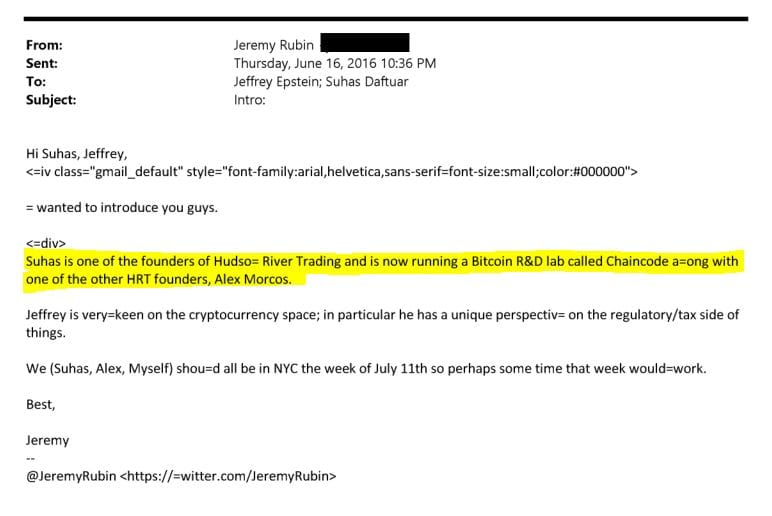
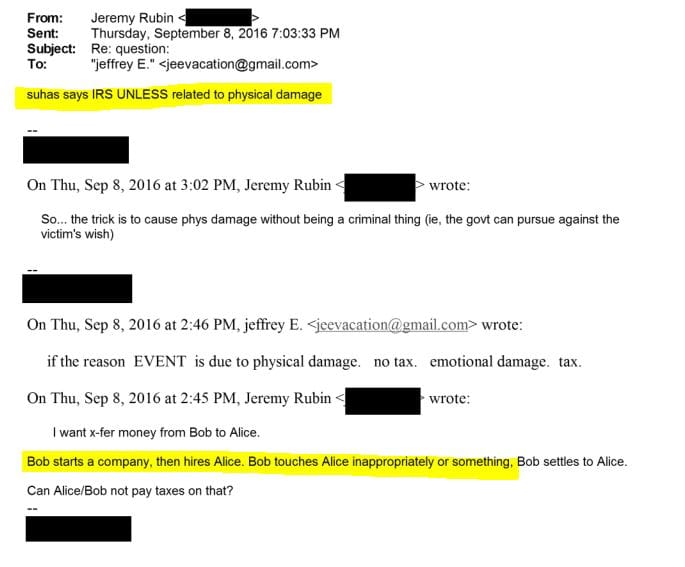
These aren't casual pings. The 2016 intro explicitly spotlights Chaincode as Daftuar's brainchild, tying Epstein's "regulatory/tax expertise" to Bitcoin's growing pains. Did the July meeting happen? The trail goes cold; no follow-ups in the files, no public records. But Rubin's later admissions confirm in-person Epstein chats on Bitcoin regs, and Daftuar's tax input shows real collaboration. Ethically murky?
Absolutely, the "physical damage" riff reeks of Epstein's worldview. Yet it underscores how Chaincode's founders were in the room, potentially absorbing (or pitching) ideas that could loop back to Bitcoin's code.
Broader threads loop in Ito and Iozzo, Epstein's crypto whisperers. Ito's MIT DCI was Epstein's beachhead, funding devs who later flocked to Chaincode. No smoking receipt for Epstein-to-Chaincode wire transfers, but the proximity screams "follow the devs and it will lead you to the money."
Dev Carousel: Blockstream, Chaincode, and Epstein's Echo
Epstein's direct hits, Blockstream and Coinbase, weren't isolated. Blockstream, flush with his $500K seed, hired a dream team of Core devs to push offchain scaling. Then, in a pattern that's equal parts talent migration and network consolidation, many jumped ship to Chaincode:
- Pieter Wuille: Blockstream co-founder and BIP author (SegWit, Taproot). Joined Chaincode as a full-time Bitcoin Core maintainer.
- Matt Corallo (BlueMatt): Early Lightning Network pioneer at Blockstream. Switched to Chaincode, bringing relay and scaling expertise.
- Clara Shikhelman: Current Chaincode engineer, but splits time hacking on Blockstream's c-Lightning implementation - a core Lightning repo.
This isn't coincidence; it's ecosystem gravity. Chaincode lured Blockstream's stars post-Epstein infusion, blending influences. Speculation swirls: Did Epstein's MIT cash indirectly juice Chaincode via these devs? Or was it Joi Ito's hidden projects, where Epstein's donations bought more than lab space? Files hint at other hidden projects. What we do know is that Epstein funded upstream; Chaincode drank from the downstream. It's all connected.
Shaping Bitcoin's Destiny: Influence, Not Just Ink
Chaincode isn't some Epstein puppet. It bootstrapped itself with Daftuar and Morcos's trading windfall, later adding sponsors like Balaji Srinivasan (16.55 BTC in 2023). Its code projects and residencies have trained hundreds. But the Epstein emails? They invite a rethink. Epstein wasn't coding commits, but his network greased the wheels: tax hacks for devs, regulatory whispers for labs, and funding funnels that kept talent flowing.
In Bitcoin's formative years, that chaotic 2014-2018 stretch of halvings, code changes, and hard forks (Block Size Wars), these connections mattered. Blockstream's offchain layers (Epstein-backed) meshed with Chaincode's onchain upgrades, birthing a hybrid future. If Epstein's hand tilted the scales, via intros, ideas, or indirect grants, it wasn't benevolence; it was control.
We created an Epstein Bitcoin Email archive to go through all the newly released Epstein emails relating to Bitcoin, cryptocurrency, and blockchain, to search through all the communications for important information relating to this topic. Try it out!