
How Noble Markets Connected Tether, Epstein, and Their Shadow Banking Network


Noble Bank was once an obscure financial institution in Puerto Rico, but for several years it quietly sat at the center of the crypto economy. Long before Tether became a dominant force and long before Cantor Fitzgerald took custody of its U.S. Treasuries, Noble handled the flows that powered early cryptocurrency markets. Its rise and fall reveal a deeper story about the people, capital, and offshore structures that shaped the first generation of crypto liquidity.
The bank’s origins trace back to New York, where former FX executive John Betts launched Noble Markets around 2014. His goal was to build an institutional settlement platform for digital assets, something closer to a foreign‑exchange venue than a retail exchange. Noble was designed for large counterparties, and from the start it attracted attention from early crypto investors who were looking for infrastructure that could support growing trading volumes.
Early Investors and Expanding Networks
One of the earliest figures connected to Noble was Brock Pierce, who was already active in venture investments through Crypto Currency Partners. Internal documents from the period show Noble listed alongside other early infrastructure companies such as Blockstream, Kraken, LedgerX, and others, and Pierce’s correspondence reveals he was promoting both Noble and Tether to high‑profile contacts.
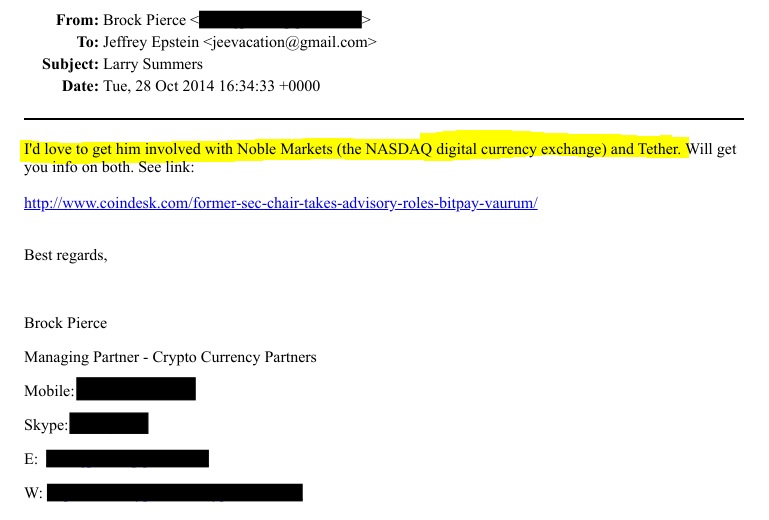
In October 2014, Pierce emailed Epstein about bringing Larry Summers into the fold for Noble Markets, signaling how aggressively he was trying to expand the network around this venture.
"I'd love to get him involved with Noble Markets (the NASDAQ digital currency exchange) and Tether. Will get you info on both," wrote Pierce in his email to Jeffrey Epstein.
As Noble grew, Betts shifted the operation to Puerto Rico, where Brock Pierce moved to and had established banking connections, and secured an International Financial Entity license.
This allowed Noble Bank International (renamed from Noble Markets to Noble Bank) to hold deposits and settle flows for clients who struggled to access traditional banking. By 2016 and 2017, Tether and Bitfinex had become Noble’s most important customers, relying on the bank during a period when their own banking relationships were unstable. Noble became a quiet but essential part of the machinery that allowed USDT to expand across global exchanges.
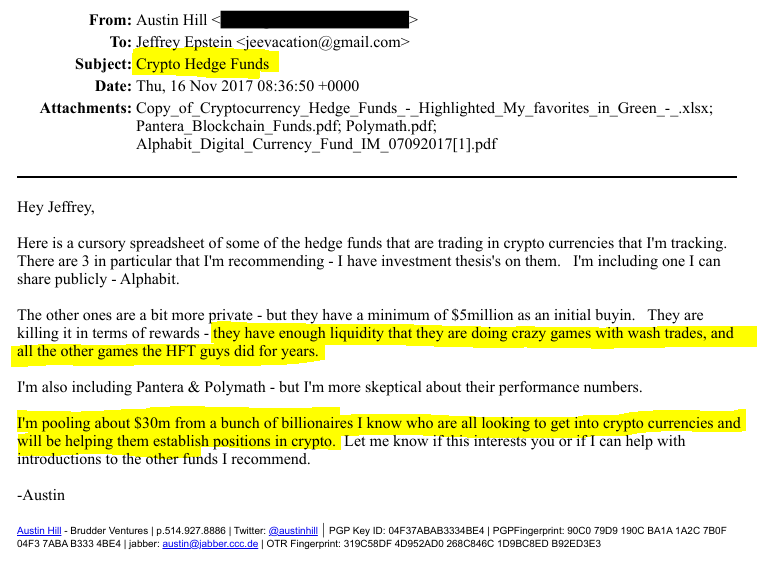
During the same period, Epstein’s involvement in crypto was more active than many realized. He had already invested millions in many early Bitcoin companies and maintained relationships with several industry insiders. In November 2017, Blockstream co‑founder Austin Hill emailed Epstein with materials on crypto hedge funds, including Alphabit. Hill described aggressive trading practices and noted he was pooling about $30 million from wealthy contacts who wanted exposure to cryptocurrencies.
"They are killing it in terms of rewards - they have enough liquidity that they are doing crazy games with wash trades, and all the other games the HFT guys did for years [...] I'm pooling about $30m from a bunch of billionaires I know who are all looking to get into crypto currencies and will be helping them establish positions in crypto," wrote Hill in his email to Jeffrey Epstein.
From Noble’s Collapse to Wall Street Custody
Noble Bank’s role in this environment was straightforward but critical. It provided the settlement layer beneath Tether’s expansion, and its fortunes were tied almost entirely to that relationship. When Tether moved its banking to Deltec in 2018, Noble’s business collapsed. Attempts to sell the bank went nowhere, and by 2019 it had effectively shutdown and ceased operations.
Tether’s next chapter unfolded with larger institutions. As its reserves shifted toward U.S. Treasuries, Cantor Fitzgerald emerged as its primary custodian. Howard Lutnick confirmed the relationship publicly, placing one of Wall Street’s most established firms at the center of Tether’s reserve management.
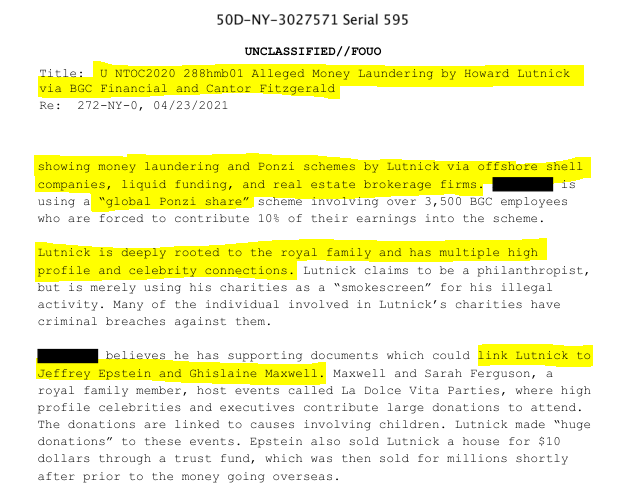
Around the same time, a 2021 FBI document now surfaced via the Epstein Files, alleges misconduct involving Lutnick and related entities.
The document says,
"Further investigation by ▇▇▇▇ linked Howard Lutnick to illegal activities with JP Morgan, Russian Hedge Funds, and other senior executives in the financial business. ▇▇▇▇ has documented proof showing money laundering and Ponzi schemes by Lutnick via offshore shell companies, liquid funding, and real estate brokerage firms. ▇▇▇▇ is using a "global Ponzi share" scheme involving over 3,500 BGC employees who are forced to contribute 10% of their earnings into the scheme.
Lutnick is deeply rooted to the royal family and has multiple high profile and celebrity connections. Lutnick claims to be a philanthropist, but is merely using his charities as a "smokescreen" for his illegal activity. Many of the individual involved in Lutnick's charities have criminal breaches against them.
▇▇▇▇ stated he has multiple regulatory reporting documents he can provide to an agent to substantiate his claims. ▇▇▇▇ would like to speak to an agent to better and more thoroughly outline and tie everything together."
Taken together, the history of Noble Markets shows how Tether and early crypto relied on a small circle of influential investors, offshore shell companies, and private capital networks connected by Jeffrey Epstein. The bank served as a bridge between emerging crypto markets and the traditional financial system at a moment when few institutions were willing to take on that role.
Figures like Brock Pierce sat at the center of that web. As an early investor in Noble, and a direct conduit to Epstein, pitching both Noble Markets and Tether to him as early as 2014, Pierce helped route capital, credibility, and connections into the very infrastructure that would later underpin Tether’s rise. His role illustrates how tightly intertwined early crypto ventures were with private billionaire networks and offshore finance.
Noble’s story helps explain how Tether grew, how early liquidity moved, and how a handful of influential figures shaped the foundations of the modern crypto economy.
Noble Markets is easy to overlook because it never became a household name, never launched a retail app, and never courted public attention. But in the background, it linked Tether, offshore banks, shell companies, Epstein's shadowy network, venture funds, and billionaire family offices into a single, fragile system.
We created an Epstein Bitcoin Email archive to go through all the newly released Epstein emails relating to Bitcoin, cryptocurrency, and blockchain, to search through all the communications for important information relating to this topic. Try it out!