
Ethereum Leads Blockchains with Highest Net Inflows in 2025


As 2025 draws to a close, Ethereum has emerged as the blockchain with the strongest net capital inflows among major networks. Onchain analytics platform Artemis reports that Ethereum recorded approximately $64.5 billion in inflows and $60.3 billion in outflows through decentralized finance bridges this year. This activity results in a positive net inflow of roughly $4.2 billion, placing Ethereum ahead of all competitors in attracting and retaining liquidity across ecosystems.
The figures highlight Ethereum’s continued dominance in DeFi despite growing competition from newer layer-1 and layer-2 networks. Capital movement tracked by Artemis includes both canonical bridges and application-specific bridges, offering a comprehensive view of how assets flow between blockchains. These bridges serve as critical infrastructure for users moving tokens, stablecoins, and other assets seamlessly across different networks.
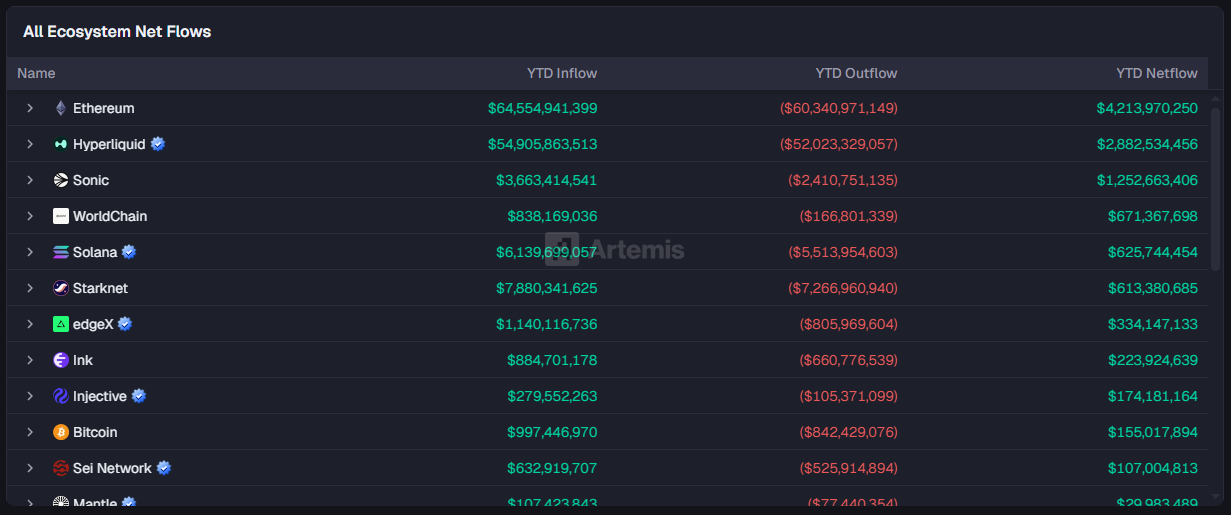
Key Competitors in Net Flows
Hyperliquid, a blockchain built specifically for perpetual futures trading and advanced DeFi infrastructure, secured second place with impressive net inflows of $54.9 billion. The platform’s focus on high-performance trading has drawn significant liquidity throughout the year. Following Hyperliquid are Sonic, WorldChain, and Solana, each demonstrating strong but lower net positive flows compared to the top two networks.
The data highlights the growing importance of interoperability in the cryptocurrency space. Decentralized bridges have become essential tools for users seeking to capitalize on opportunities across multiple blockchains without relying on centralized exchanges. This trend reflects broader market maturation, where liquidity providers and traders prioritize networks that offer efficient cross-chain access alongside robust decentralized applications.
Ethereum’s lead in net inflows comes at a time when the network has benefited from sustained upgrades and ecosystem expansion. Layer-2 scaling solutions have reduced transaction costs and improved speed, encouraging greater activity from both retail and institutional participants. Meanwhile, the consistent inflow-outflow balance suggests that capital entering Ethereum tends to stay within its ecosystem longer than on many rival chains.
Stay In The Loop and Never Miss Important Crypto News
Sign up and be the first to know when we publishFor Hyperliquid and other rising networks, the strong performance indicates that specialized use cases can attract substantial capital even in a competitive landscape. Perpetual futures trading volume has grown markedly in 2025, and platforms optimized for this activity have captured a meaningful share of overall DeFi flows. Sonic and WorldChain have similarly benefited from targeted development efforts that address specific user needs within the broader blockchain environment.
Solana’s position further down the ranking still reflects healthy activity, driven by its high-throughput capabilities and vibrant memecoin and NFT communities. Yet the gap between Solana and the leaders illustrates the challenge of converting raw transaction volume into sustained net capital retention. We note that bridge efficiency, security track records, and application diversity all influence where liquidity ultimately settles.
Overall, the 2025 bridge flow data from Artemis provides a clear snapshot of capital preferences as the year ends. Ethereum’s top ranking reinforces its position as the primary settlement layer for decentralized finance, while newer contenders demonstrate that innovation in specific niches can yield significant results. As cross-chain infrastructure continues to evolve, these inflow patterns will likely shape network development priorities heading into 2026.