
Epstein’s 2018 Bitmain Investment Deal That Came Down to the Wire

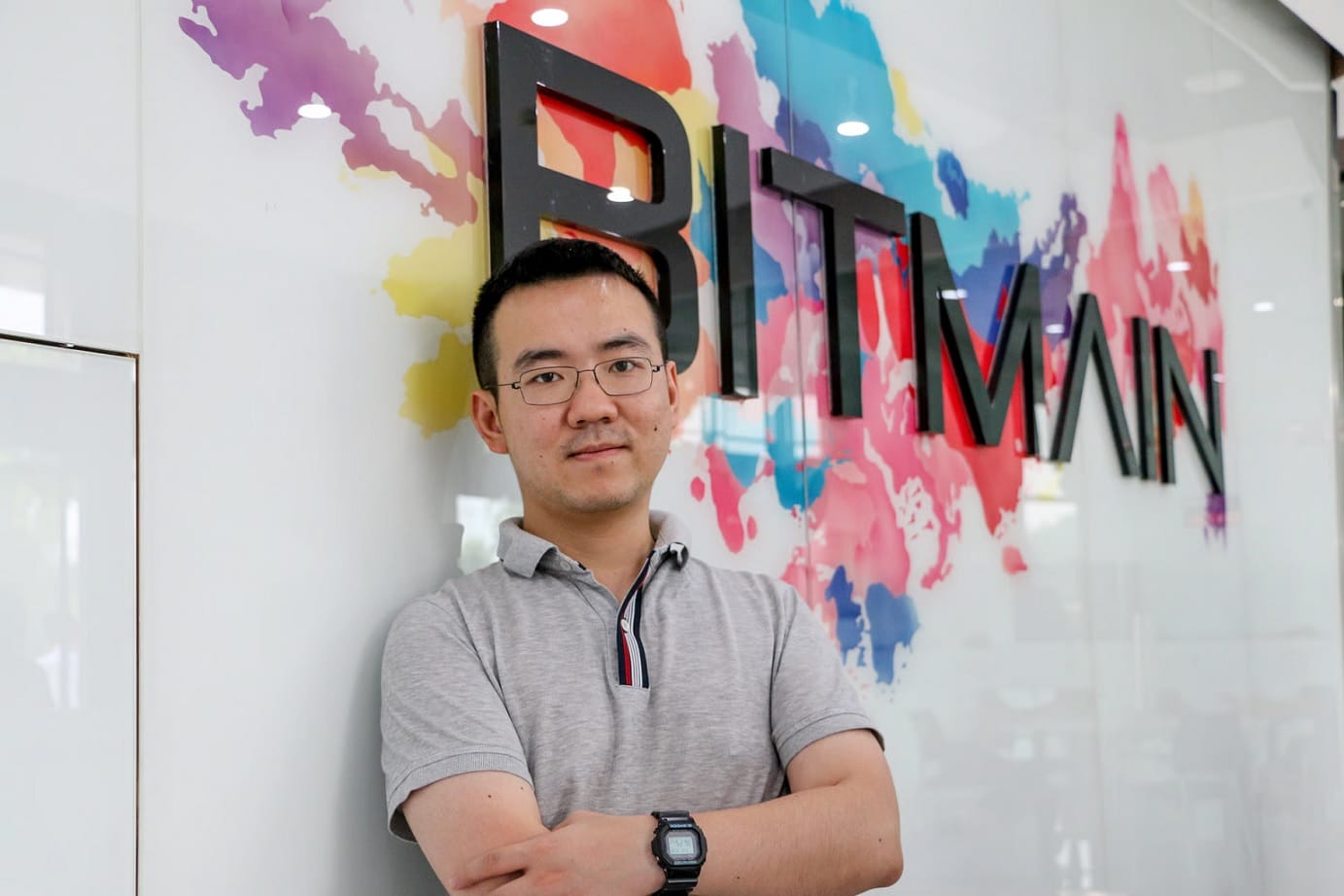
Newly released documents from the Jeffrey Epstein files reveal that in August 2018, at one of the Bitcoin mania heights, Epstein and his inner circle were actively negotiating a direct investment in Bitmain, the Chinese Bitcoin and crypto mining hardware giant then valued at roughly $14 billion and eyeing a Hong Kong IPO.
The deal never made headlines until now. Through our investigation, we found the deal was routed through a convoluted double-layered SPV structure, discussed in a rapid email chain, and ultimately appears to have been left hanging when Epstein cited a doctor’s appointment and the group failed to pull the trigger before the last minute investment deadline.
Whether money actually changed hands remains unknown, and the opacity of Epstein’s financial web, combined with Bitmain’s own secrecy as a private Chinese company, makes it nearly impossible to say for sure, at least for now.
A $1 Million Slice of Bitmain’s B+ Round
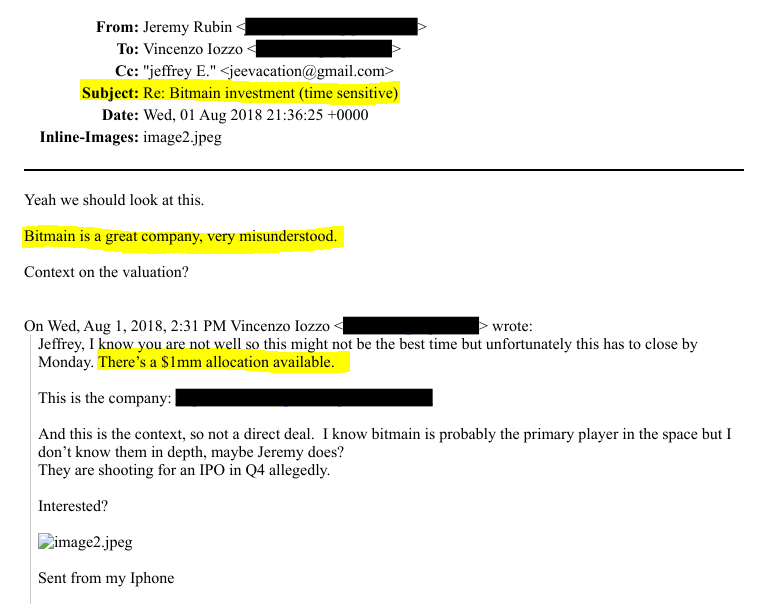
On August 1, 2018, Vincenzo Iozzo emailed Epstein with an urgent opportunity:
“Jeffrey, I know you are not well so this might not be the best time but unfortunately this has to close by Monday. There’s a $1mm allocation available… They are shooting for an IPO in Q4 allegedly. Interested?”
Attached were screenshots and context. Bitmain was raising up to $1 billion in a “B+” round at a $14 billion pre-money valuation, following a $400 million Series B just weeks earlier at $12 billion. The company dominated ASIC mining hardware (75% market share) and was posting eye-popping profits: $1.25 billion in 2017 and $1.1 billion in Q1 2018 alone.
Jeremy Rubin, a Bitcoin Core developer and investor alongside Epstein, quickly jumped in and gave the green light:
“Bitmain is a great company, very misunderstood… I think it is a great company to nab some exposure to, and I think we should do it.”
Rubin highlighted Jihan Wu’s business acumen, Bitmain’s pivot toward AI, and the IPO as the perfect proxy for investors who wanted crypto exposure without holding actual bitcoin.
Epstein’s accountant, Richard Kahn, was looped in and noted that real-money players like Coatue Management (the legitimate hedge fund, not Kahn’s separate shell entity Coatue Enterprises LLC) were already investing.
The Structure: Classic Epstein-Style Opacity
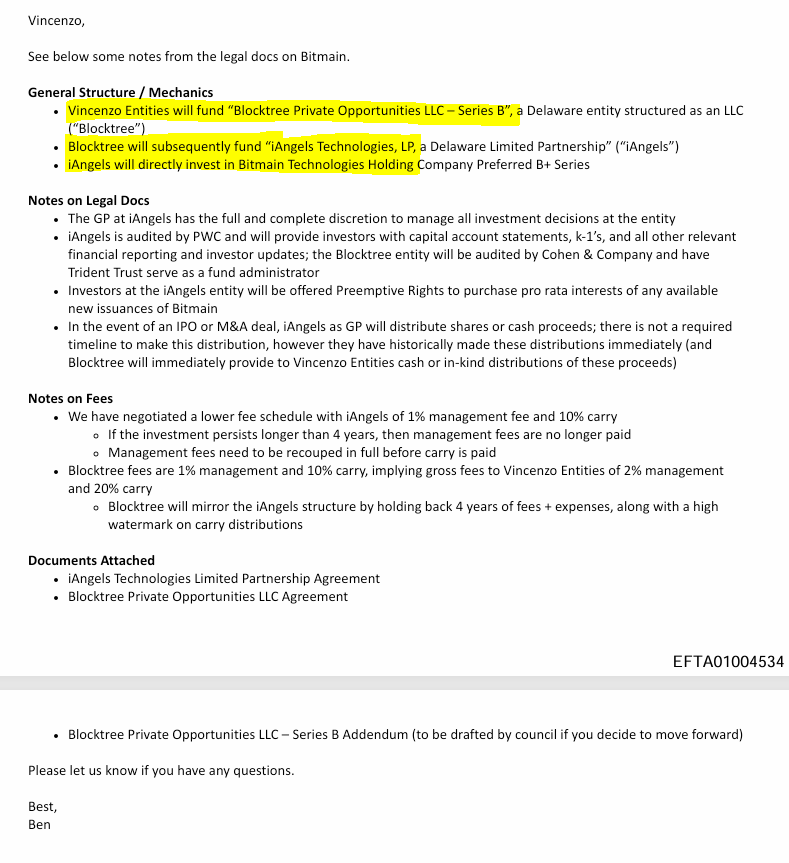
The proposed vehicle was anything but straightforward, and involved several steps and money transactions to conceal the investment:
- Epstein’s entities would fund Blocktree Private Opportunities LLC – Series B (a new Delaware LLC).
- Blocktree would then invest in iAngels Technologies, L.P. (an existing series limited partnership).
- iAngels would buy Bitmain Preferred B+ shares directly.
Fees were negotiated down to a gross 2% management + 20% carry (plus a proposed 1% closing fee). The General Partner had “full and complete discretion.” Distributions after an IPO or sale were historically immediate, but not contractually guaranteed.
Epstein immediately flagged the risks saying “structure is the weak link… you can end up with a document, and no shares.”
The Final Hours: Tomorrow Wires, Then Radio Silence
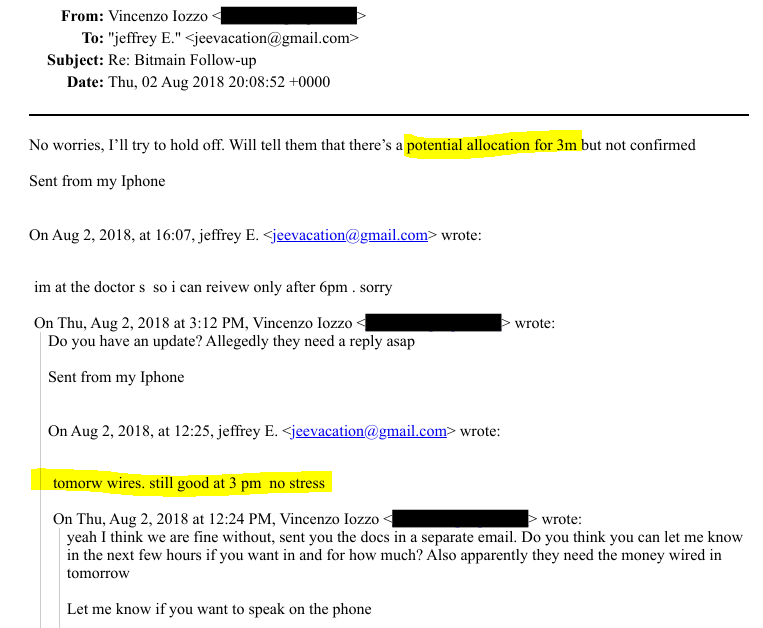
On August 2, Epstein replied: “tomorw wires. still good at 3 pm no stress.” Vincenzo pushed for a commitment, noting wires were expected “tomorrow.” Epstein, citing a doctor’s appointment, said he couldn’t review documents until after 6 p.m.
That evening, Vincenzo wrote the last message in the chain that we have been able to find:
“No worries, I’ll try to hold off. Will tell them that there’s a potential allocation for 3m but not confirmed.”
The thread ends there. No wire confirmations, no signed subscription agreements, no K-1s, and no follow-up emails appear in the released Epstein emails related to the Bitmain deal closing. The $1-3 million allocation was never publicly confirmed.
The Money Trail Is Almost Impossible to Follow
This was textbook Epstein financial concealment and architecture: layered Delaware LLCs and LPs, high carry fees, discretionary distributions, and shells like Coatue Enterprises LLC (registered 2015 at Kahn’s HBRK Associates address and later named in estate litigation).
Bitmain itself was already an opaque Chinese unicorn with limited disclosures even in its withdrawn 2018 HKEX IPO filing. Public investor lists from the 2018 rounds only name big names like Sequoia China, GIC, Coatue Management, DST, and omit small SPV side deals.
Epstein had already shown serious interest in crypto by this time. He was an investor in Blockstream, Coinbase, and funneled millions into Bitcoin through Brock Pierce's Crypto Currency Partners fund. Bitmain would have fit the pattern perfectly: a high-upside hardware play at the peak of the 2017-2018 bull market.
The Deal Was Close, But Unconfirmed
The documents show real momentum. Rubin was bullish, Kahn was facilitating, fees were negotiated, and Epstein signaled readiness to wire the funds. But the deal’s structural complexity, Epstein’s health issues that day, and the Friday deadline appear to have killed it. Or at least, pushed it into the shadows for prying eyes not to see.
We may never know the final chapter. The Epstein files are vast but incomplete, and the money trail through layered funds is deliberately murky, as well as the actual banking records including any wire transfers. What we can say with certainty is that in August 2018, Jeffrey Epstein and his network came remarkably close to owning a piece of one of crypto’s most powerful Bitcoin mining companies.
Whether the wires ever left the account remains one of the many unanswered questions in the Epstein saga.
We created an Epstein Bitcoin Email archive to go through all the newly released Epstein emails relating to Bitcoin, cryptocurrency, and blockchain, to search through all the communications for important information relating to this topic. Try it out!