
Epstein Emails Renew Debate Over America's Missing Gold Claims


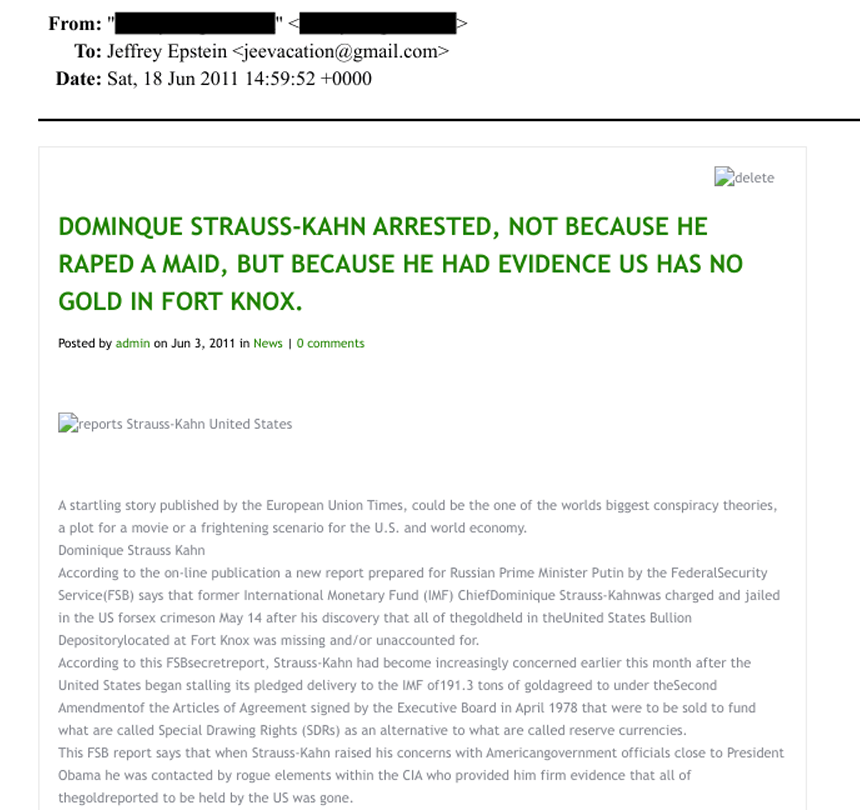
The release of documents tied to Jeffrey Epstein has revived a long‑running question that sits at the edge of finance, politics, and national trust. Emails from 2011, resurfacing in the latest files, has drawn new attention to claims that the United States’ gold reserves at Fort Knox may not be fully accounted for. The email message references a sensational article alleging that former IMF chief Dominique Strauss‑Kahn uncovered evidence that U.S. gold was "gone," and that his arrest was connected to that discovery.
The email itself does not contain original analysis from Epstein. It appears to be a forwarded article sent to him on June 18, 2011, by a sender whose name is redacted. The headline included in the message mirrors the language of the article published by The European Union Times, a site known for dramatic geopolitical stories.
What the Email Claimed and What the Record Shows
The article circulated in the email alleged that Strauss‑Kahn learned that gold stored at the United States Bullion Depository at Fort Knox was missing or unaccounted for. It further claimed that the United States delayed delivery of more than 191 metric tons of gold owed to the IMF, and that Strauss‑Kahn raised concerns with officials close to President Barack Obama. The story also asserted that "rogue elements" within the CIA provided him with evidence that the gold was gone, prompting him to attempt to leave the country before being arrested.
None of these claims are supported by any publicly available documentation that we can find. There is no FSB report confirming the allegations, no CIA records, no IMF filings, and no court documents linking Strauss‑Kahn’s arrest to gold reserves. The confirmed evidence is straightforward as that is all we have to go on at the moment. Strauss‑Kahn was arrested in New York on May 14, 2011, on sexual assault charges that were later dismissed due to inconsistencies in the accuser’s testimony; later a civil case was held where Strauss-Kahn settled out of court for a reported $6 million. He resigned from the IMF shortly after, and no additional reporting has ever tied his case to Fort Knox.
The broader debate persists because the United States has not conducted a full, independent audit of Fort Knox since 1953. Partial inspections took place in 1974 and again in 2017, when Treasury Secretary Steve Mnuchin visited the vaults. While Treasury officials maintain that all gold is present and accounted for, the absence of a modern, third‑party audit continues to fuel skepticism.
Official figures list the U.S. gold position at roughly 8,133 metric tons, with Fort Knox holding about 147 million troy ounces. The government records its gold at a statutory value of $42.22 per ounce, placing the book value near $11 billion, though the market value exceeds $600 billion. These numbers appear on Treasury balance sheets and are reported to international institutions, yet the lack of contemporary verification leaves room for doubt among critics.
Calls for transparency intensified in 2025 after public comments from President Trump, who repeatedly mentioned the idea of visiting Fort Knox to confirm the gold’s presence. Treasury Secretary Scott Bessent stated that the gold is audited annually, though no independent audit has been released. A year later, no such review has taken place, and no timeline has been announced.
The Epstein emails don't provide evidence that Fort Knox is empty. The message here reflects belief and repetition; as they say, where there is smoke, there is fire. This isn't always the case but maybe there is something to it. However, the claims remain unproven, and the official record continues to assert that the gold is there and secure.
This debate matters because questions about gold reserves influence both traditional markets and the Bitcoin and crypto markets. Gold functions as a confidence‑driven asset, and even unverified claims can push investors toward safe‑haven positions during periods of uncertainty. Crypto markets often respond to the same shifts in trust.
When confidence in institutional backstops weakens, Bitcoin’s appeal as an alternative store of value tends to strengthen. Periods of heightened skepticism toward governments and central banks have historically coincided with increased attention on decentralized assets.