
Bitcoin Pioneer Gavin Andresen Rejected Epstein, New DOJ Email Files Reveal


The U.S. Department of Justice has released millions of pages of records related to Jeffrey Epstein as part of transparency measures under the recently enacted Epstein Files Transparency Act. These documents, made public in late January 2026, shed light on Epstein's wide-ranging interests and connections in the years leading up to his legal troubles. Among the revelations are emails from 2011 showing Epstein's early fascination with Bitcoin, including persistent efforts to connect with one of the cryptocurrency's most prominent early developers, Gavin Andresen.
Epstein, a financier whose controversial activities later drew intense scrutiny, expressed interest in Bitcoin during its nascent stages when the digital currency was still largely unknown outside niche tech circles. In a June 4, 2011 email to his "pal" entrepreneur Jason Calacanis, Epstein wrote that he wanted to get in touch with the "bit coin guys" and noted he was pleased to see Calacanis succeeding. Calacanis responded by offering to provide contact information, describing the Bitcoin developers as open-source enthusiasts motivated by ideals similar to those behind WikiLeaks or Wikipedia, rather than commercial ventures.
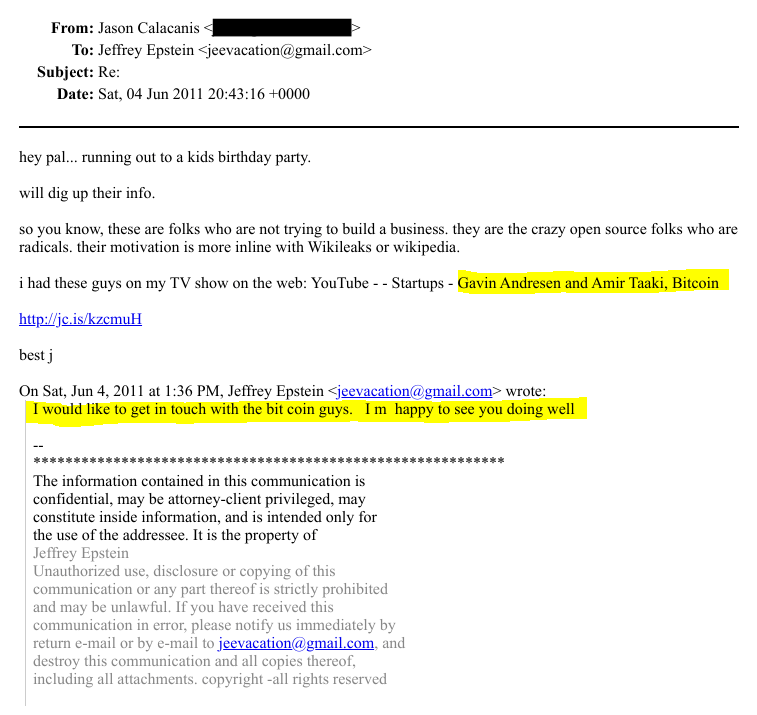
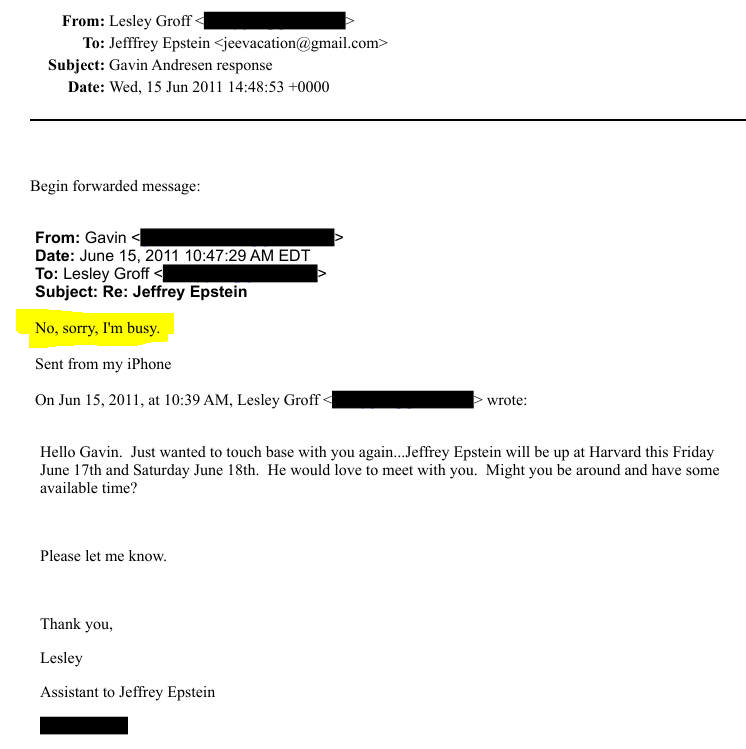
Over the following days, Epstein pursued introductions through his network. He reached out to literary agent John Brockman, who eventually supplied Andresen's email address on June 11. By June 13, Epstein indicated he planned to contact Andresen directly, and on June 15, his associate Lesley Groff sent an invitation on his behalf, noting that Epstein would be at Harvard on June 17 and 18 and would appreciate meeting Andresen if he had availability.
Andresen Declines Invitation Amid Epstein's Growing Bitcoin Interest
Andresen, who had been handpicked by Bitcoin's pseudonymous creator Satoshi Nakamoto to lead development after Nakamoto's departure in 2010, responded briefly to the invitation. His reply, sent hours later, simply stated, "No, sorry, I'm busy." There is no evidence in the released documents of any further communication or meeting between the two.
Andresen's decision to decline stands in contrast to Epstein's later documented engagements with other figures in the Bitcoin ecosystem. The files indicate Epstein went on to meet or invest alongside individuals associated with projects like Adam Back from Blockstream and and Brock Pierce from Tether, as well as contributing funds that supported Bitcoin Core development through donations to MIT's Media Lab in subsequent years.
The 2011 correspondence shows Bitcoin's early appeal to influential outsiders, even as the project navigated challenges without centralized funding or leadership. Andresen's role during this period was critical, as he guided the open-source protocol through technical and community hurdles while preserving its decentralized ethos. His concise rejection of Epstein's overture reflects a focus on development priorities over personal networking with high-profile financiers.
These revelations from the Epstein files provide a glimpse into the independent nature of Bitcoin's foundational era. While Epstein pursued involvement in the space and later channeled resources toward related startups and people, Andresen's response suggests a deliberate distance from such influences.
The documents also raise questions about external interests in emerging technologies during their formative phases. Epstein's unsuccessful attempt to engage Andresen directly, followed by his broader activities in crypto, illustrates the varied paths through which outside capital eventually entered the ecosystem. For Bitcoin enthusiasts, Andresen's actions serve as a reminder of the project's roots in principled, volunteer-driven development free from compromising entanglements.
Stay In The Loop and Never Miss Important Bitcoin News
Sign up and be the first to know when we publishAndresen to Blockstream: Bitcoin’s New Era
The years that followed would mark a turning point in Bitcoin’s internal governance. After Andresen declined Epstein’s outreach, an overture that, if accepted, might have introduced outside funding or influence into Bitcoin Core; the project continued to evolve under mounting technical and political pressures. By 2014, Andresen’s role within the Core repository changed dramatically. His commit access was removed amid claims that his account had been compromised, a justification that many in the community later questioned. Despite his long‑standing leadership and his central role in stewarding Bitcoin after Satoshi’s departure, his access was never restored.
In the vacuum that followed, a new cohort of developers emerged as the dominant force shaping Bitcoin’s technical direction. Contributors associated with Blockstream: including Adam Back, Gregory Maxwell, Pieter Wuille, and others, became the primary maintainers guiding protocol development. Their stewardship coincided with a philosophical shift in how Bitcoin should scale. Rather than expanding on‑chain capacity, the prevailing vision emphasized off‑chain and layer‑two solutions such as the Lightning Network, a direction that continues to define Bitcoin’s roadmap today (see also Block Size Wars).
For many, this transition just shows how pivotal moments in Bitcoin’s early history, including who accepted or rejected outside influence, helped determine the project’s long‑term trajectory. Andresen’s brief, dismissive reply to Epstein now reads as part of a larger story about independence, governance, and the competing visions that shaped Bitcoin during its formative decade.
We created an Epstein Bitcoin Email archive to go through all the newly released Epstein emails relating to Bitcoin, cryptocurrency, and blockchain, to search through all the communications for important information relating to this topic. Try it out!