
Argentina's Javier Milei Secret Blockchain Deal Surfaces as LIBRA Investigation Intensifies


Argentinian prosecutors have uncovered a confidential blockchain advisory agreement linking President Javier Milei to Libra co‑creator Hayden Davis, adding new pressure to the country’s stalled investigation into the collapse of the LIBRA token.
According to reporting from Argentinian news outlet La Nación and sources familiar with a January 9 forensic review, multiple drafts of the agreement were recovered from the seized phone of Mauricio Novelli, a lobbyist tied to the token’s launch. The document appeared in several iterations exchanged between Novelli and Davis before the final version was reportedly signed by Milei.
The president continues to deny that any such agreement exists, despite investigators identifying language that formalized Davis’ role as a blockchain advisor ahead of LIBRA’s February 14, 2025 debut. Novelli is one of several figures accused of helping orchestrate the token’s rollout and benefiting from its rapid collapse, alongside Manuel Terrones Godoy and Sergio Morales.
Recovered Messages Point to Coordinated LIBRA Launch Effort
Prosecutor Eduardo Taiano said the findings now require the undersecretary of presidential affairs, who reports to Milei’s sister and General Secretary Karina Milei, to confirm whether her office holds copies of the disputed agreement. Forensic analysts also concluded that Novelli played a central role in organizing the LIBRA launch while maintaining contact with Milei, his sister, Davis, Terrones Godoy, Morales, and Julian Peh, the CEO of the KIP protocol that supported the token’s deployment. Investigators noted that many messages between Novelli and other parties had been deleted, though some were recovered through extraction tools.
One recovered exchange involved Cardano founder Charles Hoskinson, who accused Terrones Godoy of requesting a five‑figure payment in exchange for a meeting with Milei. Hoskinson declined, saying he had been promised that “magical things will happen,” but refused to participate. The interaction adds another layer to the growing list of questionable outreach efforts surrounding the token’s launch period.
We previously reported that Milei signed the confidential agreement with Davis 15 days before LIBRA went live. The arrangement was covered by a non‑disclosure agreement and required Davis to provide unpaid advisory work described as “ad honorem.” The document stated that Davis would offer professional support aligned with global decentralization trends while maintaining strict confidentiality throughout the advisory process.
On the same day the agreement was signed, two USDC transfers totaling roughly $1 million were sent from wallets linked to Davis to an address belonging to Orlando Rodolfo Mellino, a 75‑year‑old retiree with no fixed residence. Mellino then forwarded the funds to a wallet associated with Novelli, according to investigators. The movement of funds has become a focal point for prosecutors as they attempt to map financial flows tied to the token’s launch.
La Nación reports that the broader LIBRA investigation has progressed unevenly over the past year, slowed by delays in releasing key forensic reports, including the analysis of Novelli’s devices. Milei has not yet appointed legal representation in the case.
Stay In The Loop and Never Miss Important Crypto News
Sign up and be the first to know when we publishPump.fun Allegations Add Pressure to Ongoing LIBRA Investigation
Davis, meanwhile, appeared to be moving freely as of December 2025, even as new questions formed around his financial activity in the months after LIBRA’s collapse. In February, crypto analytics firm Bubblemaps said he earned roughly $15 million from Pump.fun’s private token sale, a claim that renewed attention on his broader involvement in the ecosystem. The timing of the alleged gains added to the scrutiny already surrounding the stalled investigation.
According to Bubblemaps’ analysis at the time, Davis had taken part in Pump.fun’s private funding round with a $50 million USDC contribution and received an allocation of 12.5 billion PUMP tokens once the token launched. The firm said those tokens were sold on the first day of trading, generating about $65 million in revenue. The details were presented as part of a broader review of early token allocations and wallet activity tied to the project.
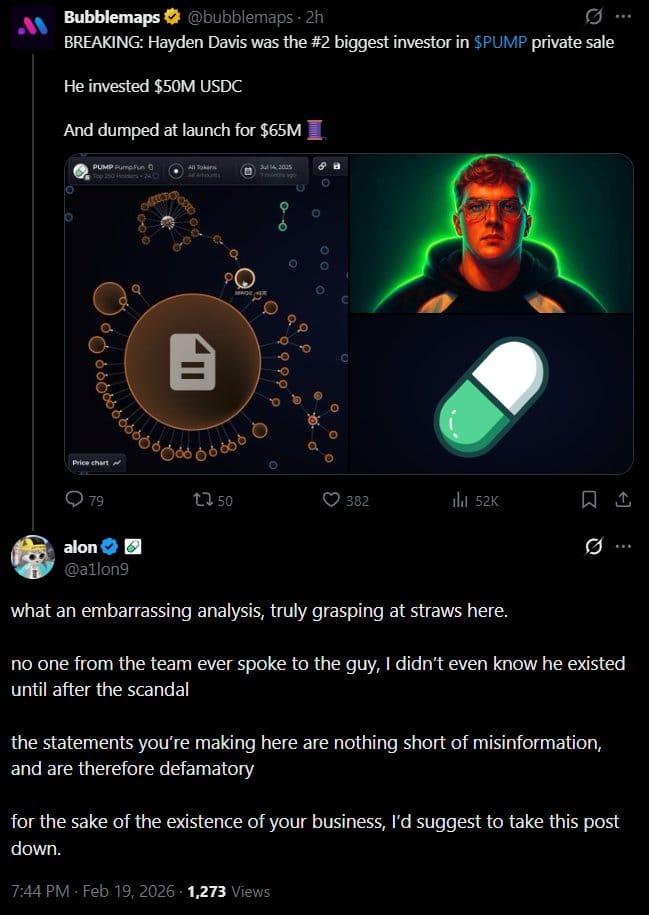
Bubblemaps later deleted its findings after Pump.fun’s pseudonymous CEO, Alon Cohen, publicly dismissed the analysis and described it as defamatory misinformation. Cohen said he had never interacted with Davis and was unaware of any involvement until after the LIBRA scandal became public. The reversal left prosecutors and analysts without clarity on the transactions Bubblemaps initially highlighted, adding another unresolved thread to a case already marked by conflicting accounts and missing records.
Earlier today, we reported on a whistleblower who published internal Pump.fun chats, alleging multiple high-severity security vulnerabilities on the platform's smart contracts.